Saturday, April 22, 2006


ELECTION DAY:

I just returned from Whole Foods, where actor Terrence Howard apologized for butting in on my grocery pile. (Nooooo problem.) Anyway, it was a nice little moment in an otherwise odd Election Day.

So, yeah, it is election day, and the neutral grounds of New Orleans are crowded with signs. At every corner, folks in candidate T-shirts wave signs. As I drove Uptown to Whole Foods, I noticed that the closer one drove to the river, (and the bigger and more expensive the houses got,) the more Ron Forman signs one saw. Landrieu's signs were popular, too, but the Uptown contingent loves their money, and they love their denial, and they love their zoo--and evidently, Ron Forman.

I find Forman annoying. Somehow this barely-democrat business man got ahold of my email address and has been filling my inbox with rhetoric about This Historic Opportunity. We are told that rarely will there be an election that matters more than this one (though I can think of a couple)--rarely will our votes count more than today.

So last night I was discussing my Historic Vote with some of my colleagues from UNO.

At first, I was all about Mitch Landrieu. In the first weeks after the storm, I remember his comments being empathetic and understanding--that he spoke about the right of everyone to return--not of the kind of racial cleansing that folks like freaky Peggy Wilson (who's used terms like "Welfare Queens" and "pimps" when referring to displaced New Orleanians) have been touting as an "opportunity." Plus, Mitch has pretty eyes and hair plugs that he seems to regret that make him somehow endearing.

But I'd told Simon that he could have my vote. Simon cares deeply about all elections--in the last presidential election, he even campaigned door-to-door--in spit of the fact that he can't vote. Simon had interviewed Tom Watson, a beJesusy pastor who is a righteous dude and a populist kind of guy, and had decided he was our man--until we saw his campaign ad that was all "Let my people go," and so Watson was out.

So we were back to square one. On Thursday, we watched a televised debate, and I listened skeptically to oneVirginia Boulet. I'd heard about her proposal to move UNO downtown--a hare-brained idea, I thought, until she talked about it. She also talked about universal health care and housing vouchers to allow displaced renters the ability to return (rents here are absolutely unforgivable outrageous, and I am SICK of people talking about f-ing supply and demand. Opportunism is opportunism--and unless you are a Republican or a business man, or you have secret conservative leanings like my future brother-in-law Tom appears to have, you will acknowledge that ANY landlord charging $2300 for a two bedroom in a neighborhood that is a shell of itself, in a city that is a shell of itself, is a straight-up JERK, to put it mildly.)

Anyway... I liked what Virginia Boulet had to say. It wasn't empty "we have a historic opportunity" rhetoric. It was We can't rely solely on tourism. It was universal health care. It was juvenile justice reform and other righteous idealistic stuff that gets the Dennis Kucinich supporter in me. So Simon and I agreed that we would vote for ideas in the primary.

But back to the Parkbview discussion with my colleagues.

So we're talking about this idea of moving UNO downtown, and I seem to be convincing people that it's a good idea. We are all very worried about the future of UNO, and there's a joke that in order to recruit a student, you have to blindfold them before dropping them off at campus. The neighborhoods surrounding the campus are very nearly destroyed. It is depressing and grim, the landscape, and it is my daily commute.

If UNO gets moved downtown, not only would improve our chances of getting better public transportation--of downtown being cleaner and better protected and generally more stable--but it would alos improve the Lakefront. The Lakefront campus fronts Lake Pontchartrain. It's prime real estate, and it could be developed into mixed-income houses that get sold for the kinds of prices Bush talked about way back in September (when he seemed to actually care). Furthermore, if permanent residents live on the lake, they are more likely to care about the lake, which is unswimmable. Perhaps we would be able to swim there again. Additionally, the neighborhoods of Lakeview and Gentilly would benefit from the new houses and commercial interests. It makes sense.

But my colleague, Kim, didn't think so. In fact, she nearly spat at me when she suggested that in voting for Boulet I was telling people like her--people who lived in and lost homes in Gentilly--to go f--k themselves.

"Kim, you're not being fair. That's not at all what I said."

"Yes, you are. You're telling me, 'f--k you.'"

If I weren't made of kinder stuff, I may have really lost it, but I tried gently to explain the benefits of the plan, and how it would, in fact, be great for her neighborhood. (Nevermind that Kim lived there for all of six months.) Still, she wouldn't relent. She looked harried and angry and lost. She pulled out a bottle of pills and took one while she talked. David--who said when she left the table that he agreed with my logic and that he really wished Kim would see it, too--looked concerned. He changed the subject and I said to Kim that we would have to agree to disagree--and that she would have to get over this notion that my vote meant "f--k you."

There are some fragile people amongst us, and it only takes an election, I guess, to break one's cool. I read an article in the NYTimes this week about mental health in Katrina victims and it worried, worried, worried me. I, too, am fragile.

So today I voted for Virginia Boulet. My old polling station--Douglas High School on St. Claude--is closed, so Simon and I walked to St. Paul Lutheran Church to vote. St. Paul's suffered roof and water damage, and so the inside looked stripped and skeletal and not at all holy, which I appreciated. I signed in and Simon and I reviewed indyvoter.org's recommendations, along with Simon's own take on some of the candidates.

Then, one of the women at the table said that Simon and I could go in together. I was ecstatic. Simon has never voted in his Whole Life!

So there were were together: I pushed the selection buttons and Simon pushed the button "cast vote," and we felt good and hopeful until my neighbor across the street accused me of "throwing my vote away."

"I don't think that letting whoever wins know that I'm about universal health care and housing vouchers and, like, an actual PLAN is 'throwing my vote away.'"

Later, though, as I drove away from Whole Foods, high on my brush with Terrence Howard, I began to worry. What if Landrieu doesn't make it to the runoff and the decision is between Forman and Nagin? What if we elect another f-ing businessman? I made that mistake in the last mayoral election, when Nagin was running on a "marketing our city" platform (some PR he provided!), and I won't make it again. Still, that idea of New Orleans being a "business" is a popular one to the Uptown upper-crusts who have returned. Forman represents the upper escelons. He represents business, not people.

And cities are not businesses. New Orleans is not a business. It is a home. Mine and thousands of folks' who would like to be able to live here, to vote here, like me.

Wednesday, April 12, 2006

I am nostalgic for the first days of our return, when brokenness and devastation had a certain charm. Charm is not the right word, of course, but at that time--in early October--life here was, well, awe-some. The scenery made our hearts swell, and the tears then were less for the pain that comes with the uncertainty of an unstable future and more for the horror of the short then-past.

What has changed? Why is it that the eagerness with which we met each other, everyone--friends-now-comrades, now fellow survivors, people who you recognized from somewhere, somewhere--an old bartender (even one who poured you weak drinks), the neighbor who you never spoke to, the weird effeminate dude who used to force himself (you thought) to leer at you even though you were sure he liked men, an acquaintance of an acquaintance who surprised you from behind a mask on Halloween--everyone back then with the joyful reunions. We talked to anyone! We talked and talked and talked and listened, too, and all of it--our being here--felt sparkling and miraculous and like: Lucky, lucky US! Because many of us WERE lucky. Really lucky.

But now we are all getting tired, so that even wedding-planning feels burdensome. I find myself pretending that I don't see so-and-so when I am in the coffee shop. While I wait in line, I examine the headlines in the paper. (And those I wish to avoid, too.) But she, too, must be pretending not to see me. She, too, is tired.

On the Nola.com forums, out-of towners show up to tell us to quit pitying ourselves, to pick our pathetic selves up by the bootstraps, to stop asking for, expecting, wanting help already because they are sick, sick, sick of our whining. I start vitriolic rants urged on by my rage. But then I stop writing because I, too, am tired. Because I, too, am sick, sick, sick of us. Of this.

Yesterday I ran into my former boss from Tulane. He, like me, loves New Orleans, a fact that came up in our conversation as if it were an unfortunate illness we're both stricken with--one we'd like to get over, thank you, (sigh). T.R. was drinking a smoothie and the child's seat of his cart was filled with bottles of Odwalla Super-Food. I had coconut milk and curry paste in mine. Our little purchased comforts.

We greeted each other and remarked on our being at the only grocery now open within miles of our house. It's the Sav-A-Center on Franklin, by the lake. When I go there on my way home from work, I have to wait in line behind droves of contractors buying hot lunches from the line. I try not to look at anyone.

T.R. asks me politely if I still have my job (New Orleans is a terrible place to be a teacher, these days.) I tell him yes and thank God and tell him the truth: that I love it, that it keeps me together. I tell him that my future at UNO, for now, looks good, in spite of the doomsday prophecies and the emails that announce delay after delay in the FEMA trailer move-ins and numbers like "15 million dollar deficit" that arrive in my inbox, impossible to understand. I think I say Thank God a second time.

I ask about his teaching at Tulane--about the situation Uptown. He says he has made 12 out-of-town offers to post-docs to teach composition (evidently Tulane only hires instructors with terminal degrees, post-K,) but that no one had bitten. "I can't pay them enough to afford the rent," he says. I nod and we talk about the f-ing rents in this city--the f-ing, f-ing, f-ing way this city is slipping away from us like the rents--spiraling out of our control (as if we ever had any control.)

"I can't imagine anyone would want to move here," I tell T.R., and we smile, sadly at each other. T.R. says he thinks that things will probably get worse in 2007, but that then things will start to get better, if we can only hang on.

We talk about needing vacations. We talk about wanting a break. He tells me if he can just get a little away-time he can make it, but that honestly it's wearing him out.

We wish each other well.

As I leave the parking lot I consider stopping at the Subway that just opened--which is announced in puffy cursive on a fluorescent pink posterboard. I decide to wait and make a sandwich. I need a new car, I remind myself. I pass a sign that reads, "Not an Exit" next to a makeshift-camp for contractors that lies on the east side of the parking lot. The men from the line sit in camping chairs and eat their take-away. One of them nods at me.
On the way home I get aggravated by shit that used to bug me: potholes and aggressive drivers in their behemoth SUVs. I curse the workers at the corner of Franklin and Robert E. Lee. They are just now putting up a traffic light, when we are just fine with the stops signs, thank you. I curse a van full of Baptists in town to gut a few homes. An old man in a slow truck pulls out in front of me at South Miro and I step on the breaks, which stop me just in time in spite of Simon's truck's tin-can-iness and his balding tires. The man gives me an apologetic wave, but I am in no f-ing mood. At home I put my purse cross-ways over my shoulder. I look out the rearview mirror and both of the side ones. I gather my things and rush inside, inside, where there's my Simon and my cats and worrisome windows with no bars.

Wednesday, April 05, 2006

This joyless spring...

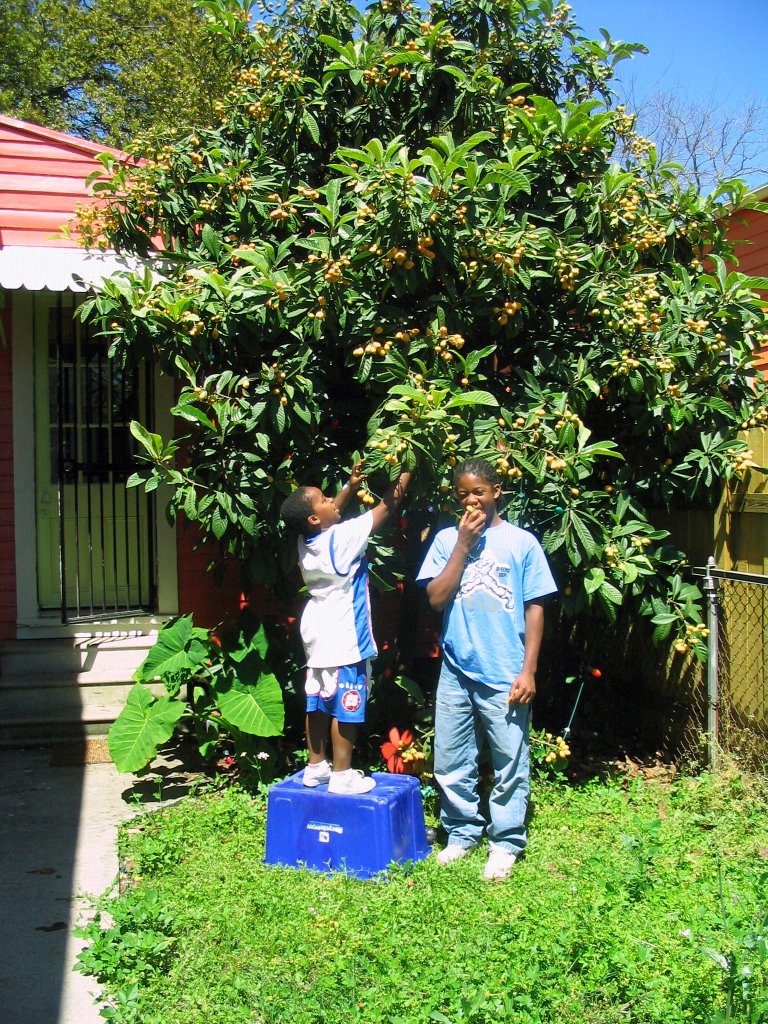
The Misbelieves in the loquat tree drop, rotten, with no children to pick them.

The buckmoth caterpillars remind me of something much more wretched than their natural selves. They are cruel politicians. They are mean-spirited tricks of mother nature. They are poisonous, spiky, angry, stupid turds, and as each fat fiend falls from our oak tree in the back yard, I am convinced that every one of them is destined to land on me.

So I avoid the backyard.

But I was doing this already. Because next door the contractors are perpetually at work on a house that will take years to finish just as it took years to paint. The owner is a viscous overseer of Mexicans, his dentures are too large for his mouth and he yells at the Mexicans in his incomprehensible dialect, louder, slower, toothier, as if they will then understand him. They bang, bang, bang but seem to get nowhere.

One of these contractors drives a car that hit mine a couple of months ago. He was drunk and drove off. I got only the last two numbers of his license plate, and for weeks he stayed away, but now there he is again, his truck with scars the size and shape that correspond with the wounds he delivered to my car that has now been hauled away. Simon hates this man in a way that I find unhealthy. He wants to play gumshoe. He takes photos of the truck while it is parked outside the bar two houses down, and I am scared. Who knows about this man. I think about the beating we witnessed a couple of weeks ago. I think about the 28-year-old who was killed later than week at 5 a.m. on Chartres street. I think about the aggression and frustration that comes with losing everything--with working long hours and sleeping in a parked car. Simon thinks about justice. I think he is too f-ing British. Naive. He angers me.
As he did that day that I saw the beating. It was the middle of the afternoon, and I was just home from teaching. I saw a grown man and a thuggish scrawny dude pushing each other and yelling. I came in and mentioned to Simon, off-handedly, that there was a fight down by the traintracks. I went out and peeked around the fence and saw the older man hitting the young guy's head against the tracks. When Simon comes out, the young guy has gained the upper hand. He has a friend with him, and his friend is dragging a galvanized steel pole to the curb, where the young guy is kicking the man's head in. I run inside and call the police. I am frantic. When I return, Simon is out playing cop again. He says he wants to help, and I tell him he is fucking crazy. Some skinny white dude with a funny accent walks up on a volatile situation. He is a witness to who knows what has even happened, and he is offering ice and help. He is a target. He is a pawn. Which is just what he becomes when the cops arrive and the young dude acts as if he has done nothing and Simon gives and incorrect description of the older man, who has fled to who knows where and the young dude is saying it was his uncle and that he just drove up in a green Suburban and started beating him. I saw very little, but I know this isn't true. When the cop is done taking my limited statement, I tell Simon how angry I am that he didn't listen to me when I asked him to stay inside. He says things like he wanted to help and I say HOW HOW HOW?! And he doesn't understand my worry or my rage. Two days later he tells me as we are driving to Metairie to pick out wedding invitations that he went down the makeshift trailer park where the fight originated (a green space filled with parked cars and trucks where tired workers sleep) to ask around. I am furious and he doesn't seem to care. He shrugs, like, "I'm sorry I mentioned it." I feel like he doesn't understand violence, like he is too privileged, too British, too naive. Part of me wishes I were, too.

Other parts of me are simply tired. My mom and dad were here to help with wedding stuff and my mom, bless her heart, asked all sorts of questions about what this or that was like before the storm and did I think they got hit particularly hard and did I think that the racial tensions are racial ones or are they class, maybe, and I wanted to crawl into a hole. A comfortable one with pedicures and margaritas and nothing, nothing, nothing related to hurricanes or politicians or race or class or beatings or shootings or sagging, rotting fruit trees or buckmoth caterpillars raining on me, giving me further reason to want to stay inside while outside it is spring but feels nothing, nothing, nothing like it.

Wednesday, March 22, 2006

This breaks my heart, completely. I am in my office, preparing for student conferences, crying. Ouch.

*From The New York Times*

March 22, 2006
Evacuees' Lives Still Upended Seven Months After Hurricane
By SHAILA DEWAN, MARJORIE CONNELLY
and ANDREW LEHREN
Nearly seven months after Hurricane Katrina flooded New Orleans and forced out hundreds of thousands of residents, most evacuees say they have not found a permanent place to live, have depleted their savings and consider their life worse than before the hurricane, according to interviews with more than 300 evacuees conducted by The New York Times.

The interviews suggested that while blacks and whites suffered similar rates of emotional trauma, blacks bore a heavier economic and social burden. And even as both groups flounder, most said they believed that the rest of the nation, and politicians in Washington, have moved on.

"I don't think anybody cares, really," said Robert Rodrigue, a semiretired computer programmer who has returned to his home in the suburb of Metairie. "New Orleans is kind of like at the bottom of the country, and they just forget about us."

The Times study is the first major effort to examine the lives and attitudes of those displaced by the storm's devastation at the six-month point, a moment when many must decide whether to establish a life in a new place or return home.

Fewer than a quarter of the participants in the study have returned to the same house they were living in before the hurricane, while about two-thirds said their previous home was unlivable. A fifth said their house or apartment had been destroyed. Many have not found work and remain separated from family members.

Still, most of those interviewed favor returning to the city, expressing a sense of optimism about the recovery process or, more often, a fierce yearning for home, as if staying away from New Orleans were like trying to breathe air through gills.

Friday, March 17, 2006

So I don't like to make a habit of laughing at my students' expense, but this is too rich. Plus, it's a Friday: time for a laugh. So here is an interpretation of Robert Frost's "The Road Not Taken" by one of my students in my online Major American Authors class:

"I guess the poem I could relate to is “The Road Not Taken,” by Robert Frost. This poem I think relates to life and life’s choices. In everyday life people have to make choices sometimes these are good choices and other times these choices are bad. For example someone decides to rob a bank; this would be a bad choice, because that person would go to jail if caught. Plus they would have a police record for the rest of their lives. On the other hand this same person could make the right choice by going to work and making an honest living. In the poem there were two roads to take one could have led to the right choices in life, and the other one that was not taken could have led down the wrong path; a path of crime and dishonesty."

Wednesday, March 15, 2006


I wish I were a cat. A domesticated one with indoor/outdoor privileges and no children in the house. I wish I were one of my cats.

I'm pretty sure that cats don't worry about work and the future and one's body suddenly seeming lumpier than usual. A cat might even luxuriate in their body being lumpier. It might strike them as a funny thing to bathe.

Mine, though--my real, live body, is lumpier in a way that I find very much un-luxuriating. (Surely this is not a word, but you know what I mean.) Is it that I am nearing 30? Or is it that I am on the Katrina-diet, which generally means bad food and lots of booze? Will I have to cut out margaritas? (Oh, I do not want to give up margaritas!) Maybe it's that I am partnered with a lean and spry thing (Simon) whose appetite mirrors mine and whose metabolism is an insatiable beast. (Simon is the only person I know who can eat three bowls of cereal at three a.m. and not pay for it.) More importantly, though, why do I CARE?

So a tee-tiny bikini arrived in the mail today to mock me. Not only does it barely cover my nipples, it is also an extra-large. So I gave Gunnar Peterson 20 on my Core Secrets space ball. Soon, though, it became un-fun. And then there was Simon in our back yard, swinging his tennis racket, jumping his rope, and generally being sweaty and active. It broke my will, so I gave up and checked my email. Oh, how I love email.

No--this entry has nothing to do with my post-Katrina New Orleans. There still are all kinds of important things to worry about in my Post-K New Orleans, sure. Like work. And the future. But for one blessed moment I will wallow in vanity and self-pity. I will remember these small concerns that were, once upon a time, a Big Deal to me. Sigh.

Oh, to be a cat!

Wednesday, March 08, 2006

Tell Bennett to EAT A DI*&*@#*K!!!!

Senator Robert Bennet (R, Utah) said in Washington today (as our local politicians were forced once again to beg for the meagerest of handouts for our struggling city that is struggling because of a FEDERALLY-CAUSED FLOOD):
"Building a city 10 feet below sea level doesn't seem to me like an inherently good idea."

Tell him your ideas at:
http://bennett.senate.gov/contact/email_opinion.cfm

And in the meantime, add a comment that lists other "inherently good ideas" that our government supports, no questions asked (or public scoldings offered.)

ARGH! I am incensed. Again.

Saturday, March 04, 2006


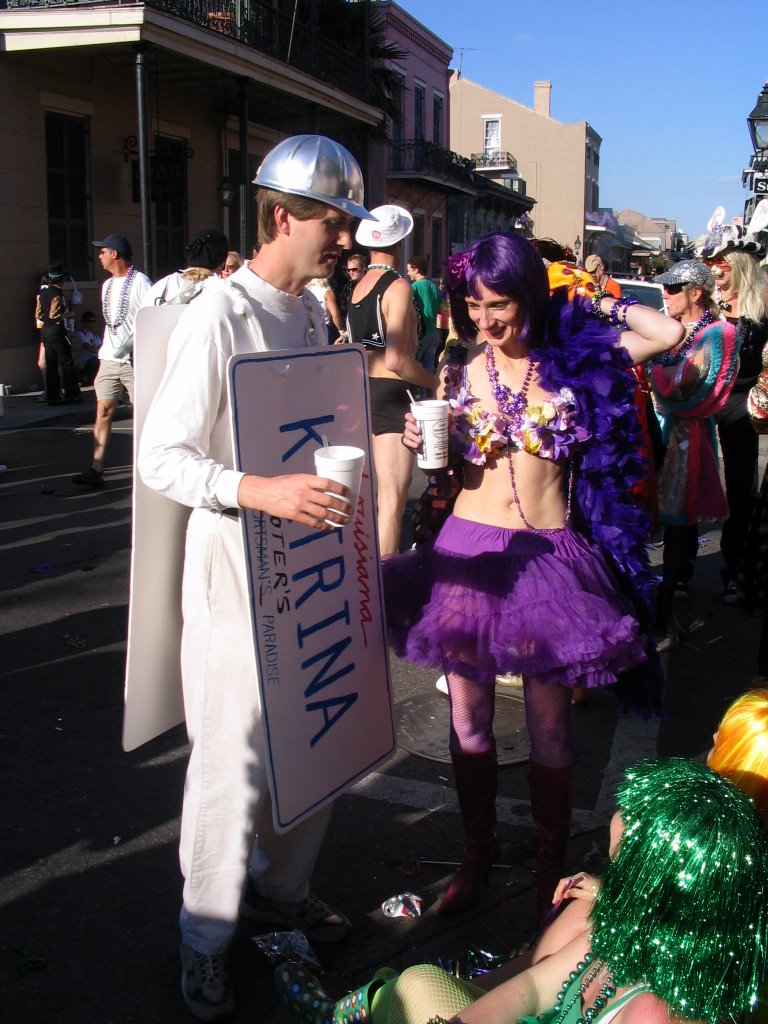
Well, I knew it would happen: Carnival season came along and distracted me from everything I "should" be thinking about--my (inconsistent) writing, my (unstable) future, my (often-interrupted) sleep. Instead, I reveled. Importantly, I reveled. And now I am on the recovery-end of the season, trying to drink more water, take more walks, sleep more soundly, and yes, keep up with my writing. (Oh, and I am also trying to do my Core Secrets exercise video. Rockin.)

I am aware that out there in the "real" (read: functioning) world, a debate was afoot about whether or not we here in New Orleans should have had Mardi Gras. I came down on the yes side. It was an easy thing for me, I suppose, given that I am living back in my (largely undamaged) home, where the worst of my worries is, um, my future. And although my present, and therefore my future, is less awful than that of many New Orleanians, I still needed to let loose. We all needed to let loose.

Here's what we did:

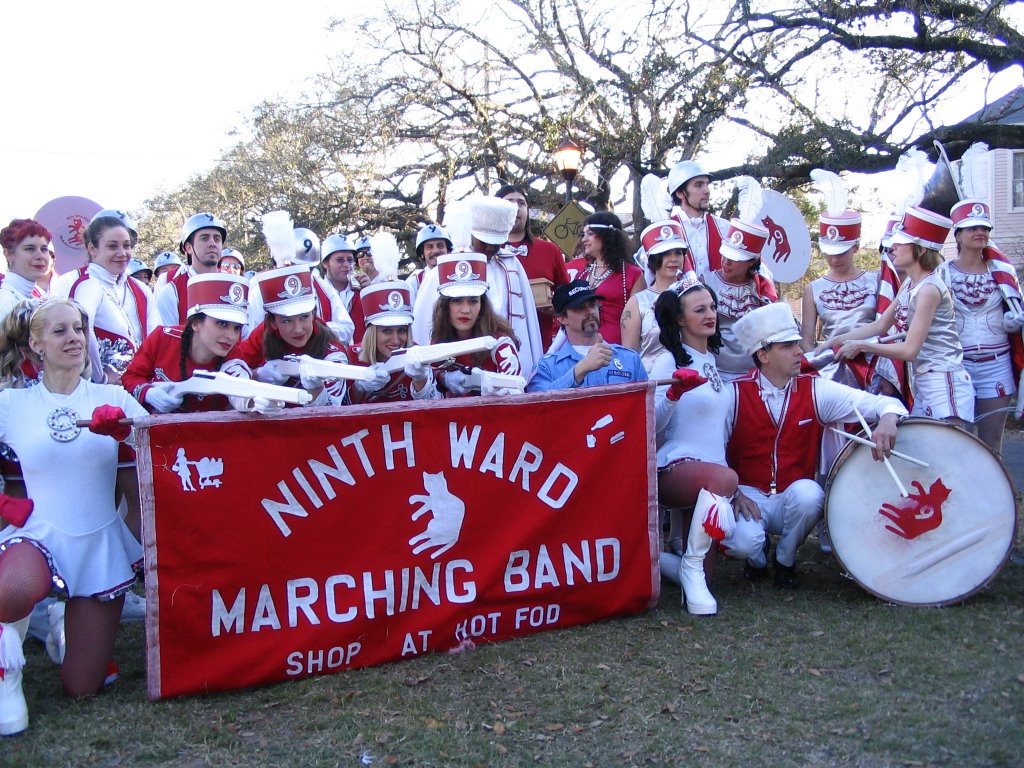
1.) I paraded (in the Muses and Proteus Parades) with the Ninth Ward Marching Band. The Ninth Ward Marching Band is an all-adult marching band that I've been in for five years. The band dates back ten and is the brainchild of Mr. Quintron and Miss Pussycat--Bywater weirdos and creative geniuses/puppeteers/inventors/musicians. I will write more about the band, as it is so so so important to me, but for now all you need to know is that it is a fun, fun, fun group that marches in uniform and this year played "Rock You Like a Hurricane" and "House of the Rising Sun." I am the captain of the cheerleaders. Again: the most fun.
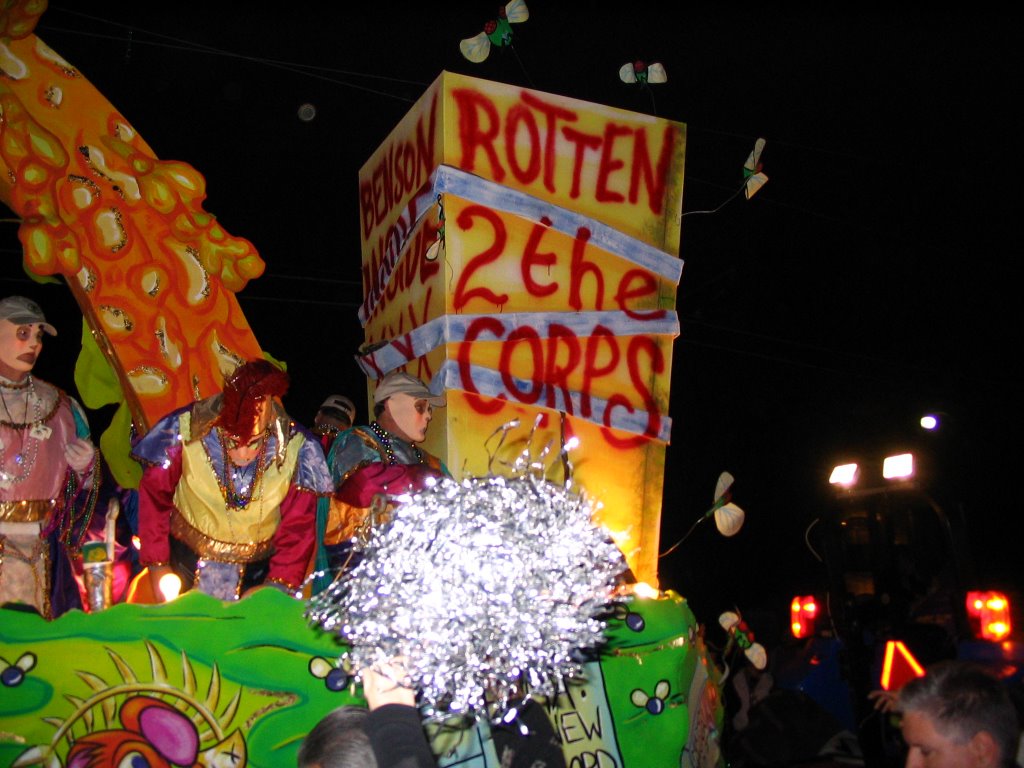
2.) Watched parades. We actually missed the first day of parades entirely, and it was very, very depressing. Five parades rolled in less than two hours, and there we were, late, expecting another one to pass, eating fried chicken and waiting, expectantly. In other years, the parades would have lasted all day. This year was different. Luckily, the later parades were in "full effect," and the themes were wonderful. The Krewe of Carrolton's was "Blue Roof Blues." Muses was "We Got Game," and each float featured a board game that lampooned local and federal politicians. Krewe D'Etat's theme was "Katrina Olympics," and they, too, lampooned Blanco, Nagin, Bush, Brownie, and Dennis Hastert (the prick who looks at us as a "financial investment," not as a city with real, live people and a rich cultural history that cannot be quantified.)

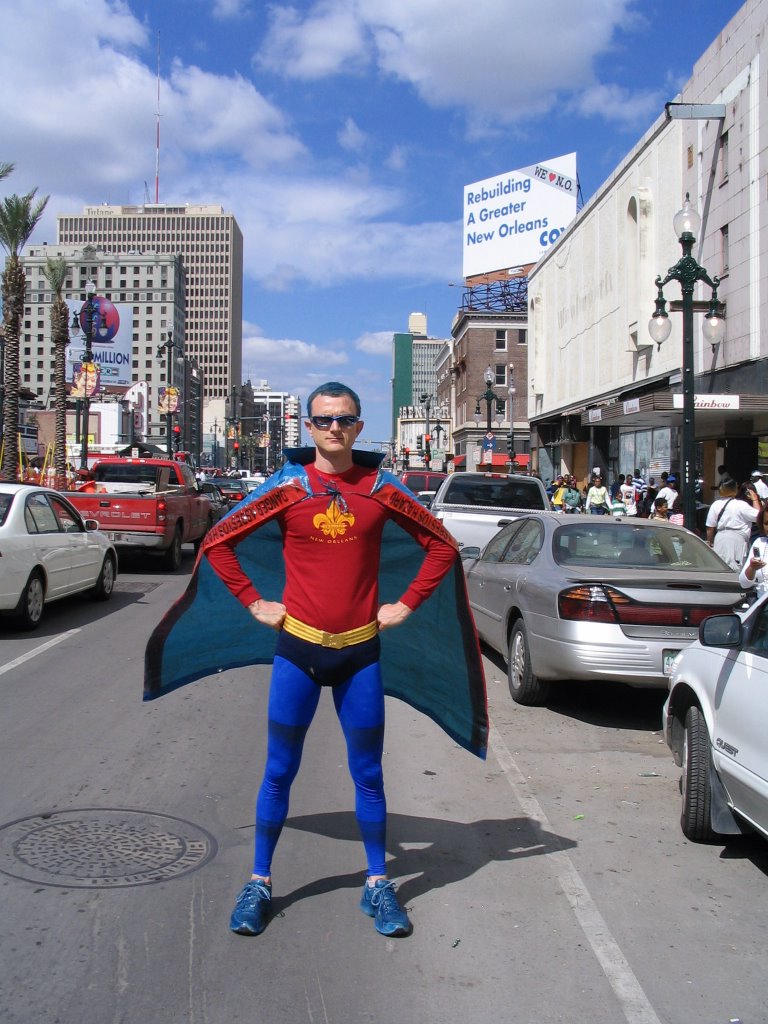
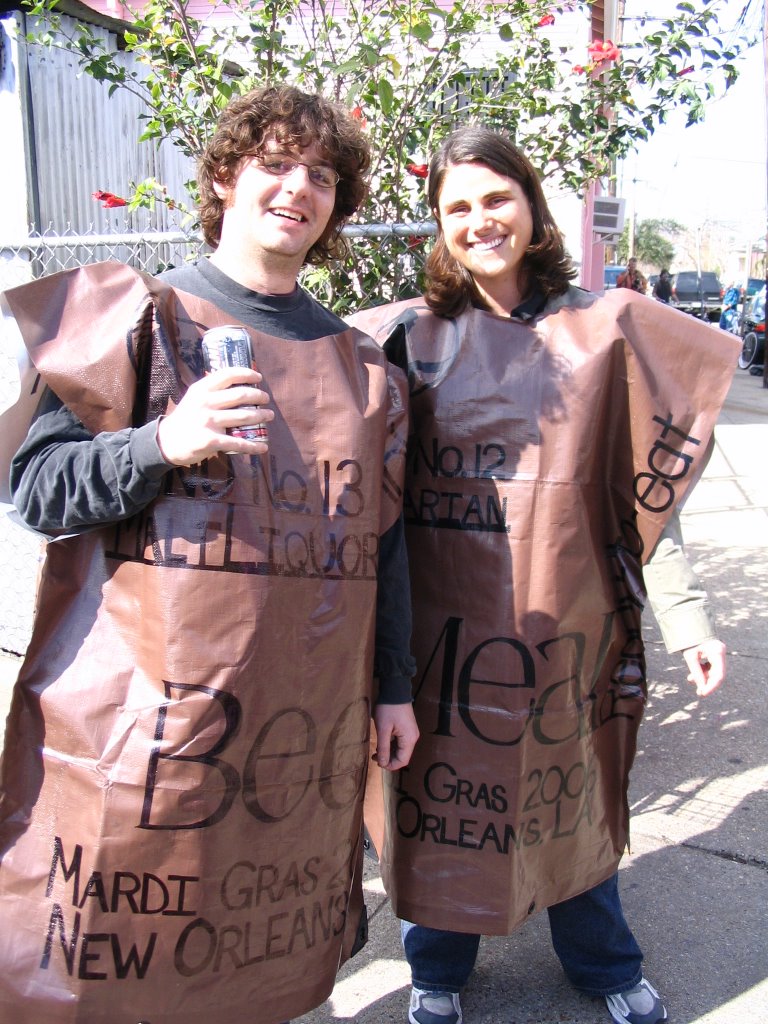
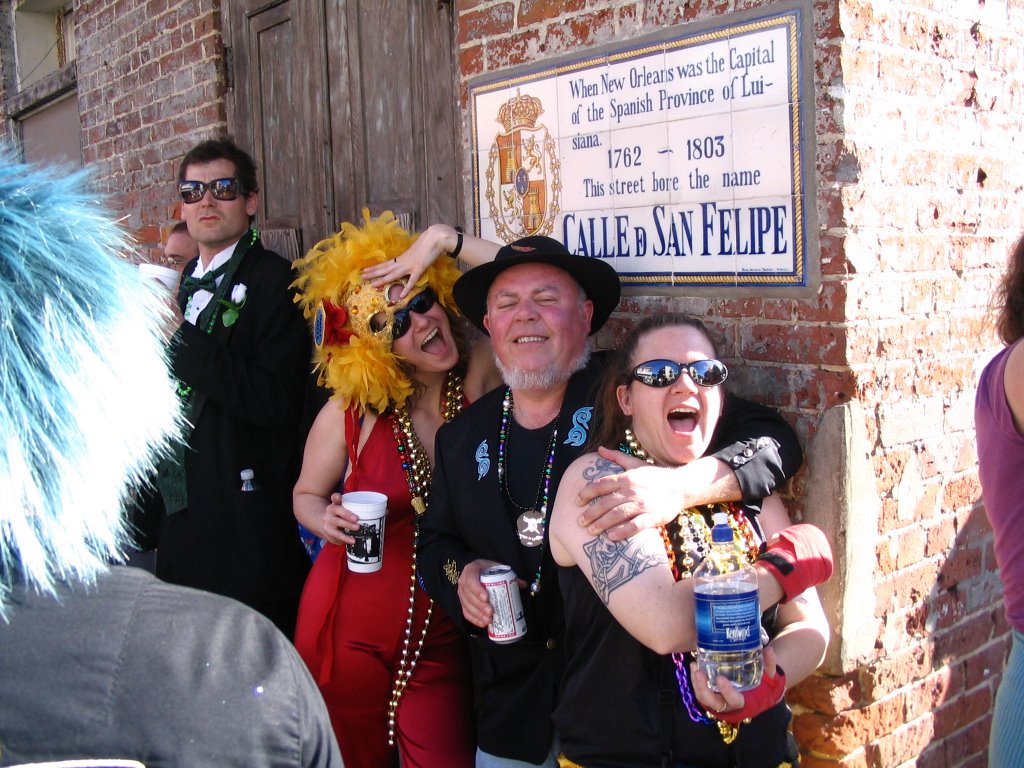
3.) Costumed. This year I brought out my famous red pant suit and put on my yellow feathered mask and was, once again, "100% Fun." Simon was a big hit in his Super New Orleans Man costume. He worked hard on it, and he posed for many a photo. Blue tarps were featured in many a costume this year, as were Meals Ready to Eat (MREs,) caution tape, and references to Brownie.
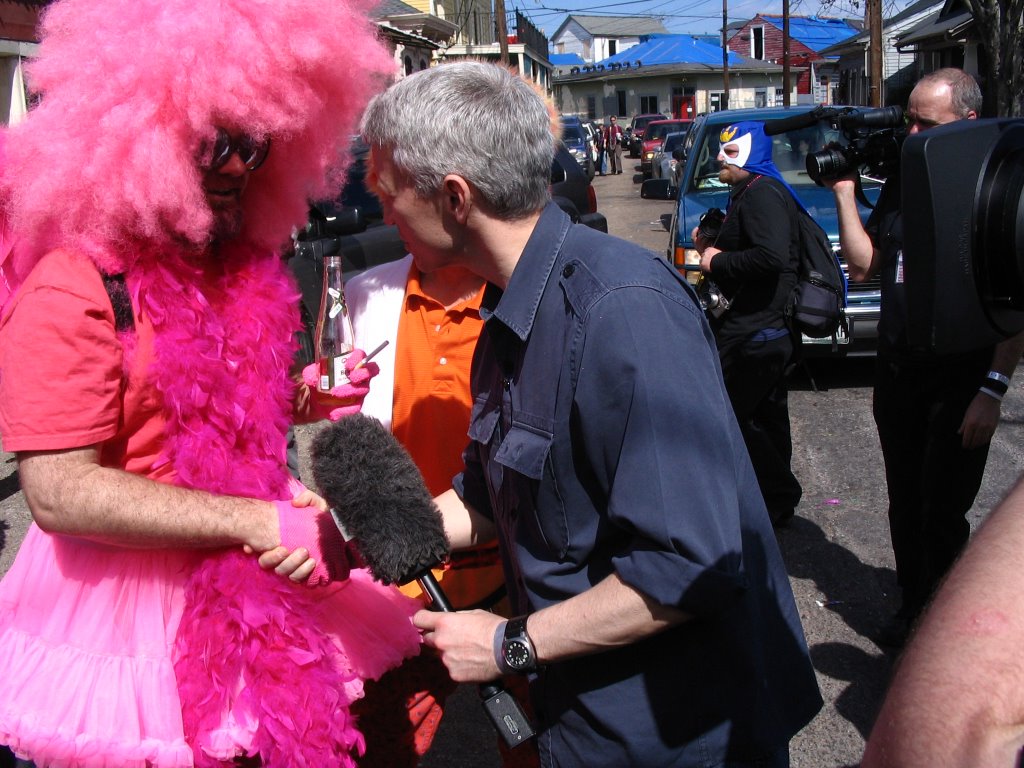
4.) Took 900 pictures of Anderson Cooper interviewing a man in a pink tutu and a giant pink afro. Cooper really does take it "360 degrees," dude. Check him out.
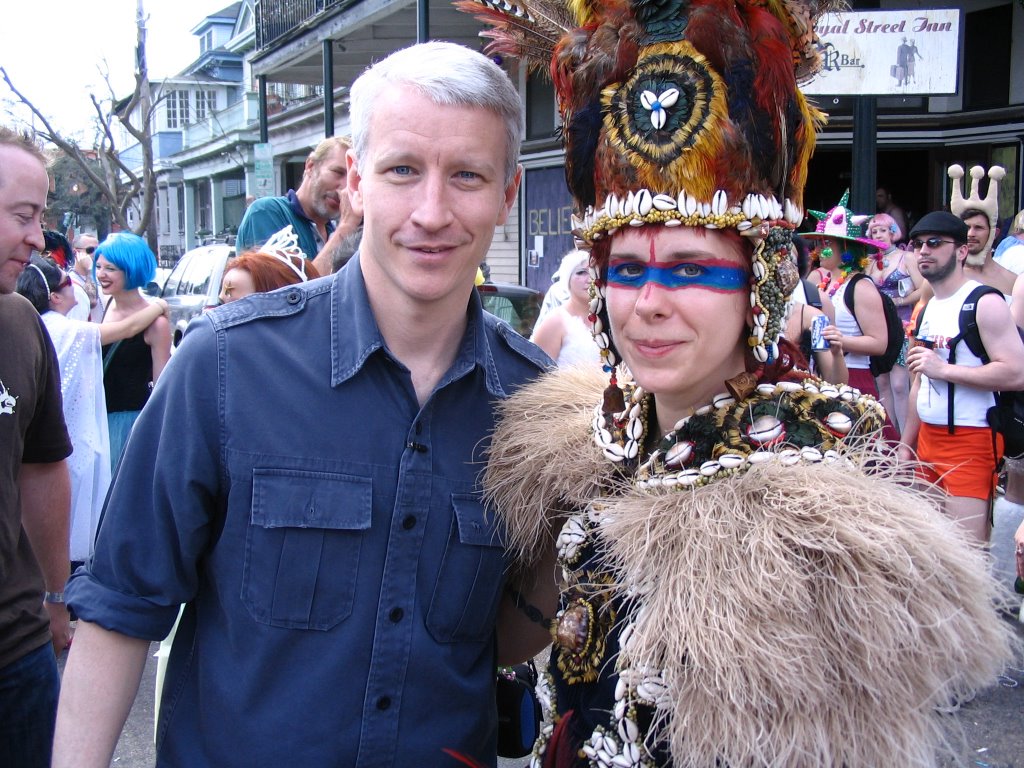
Also, check out my friend Jackie, who makes the most amazing tribal costumes.
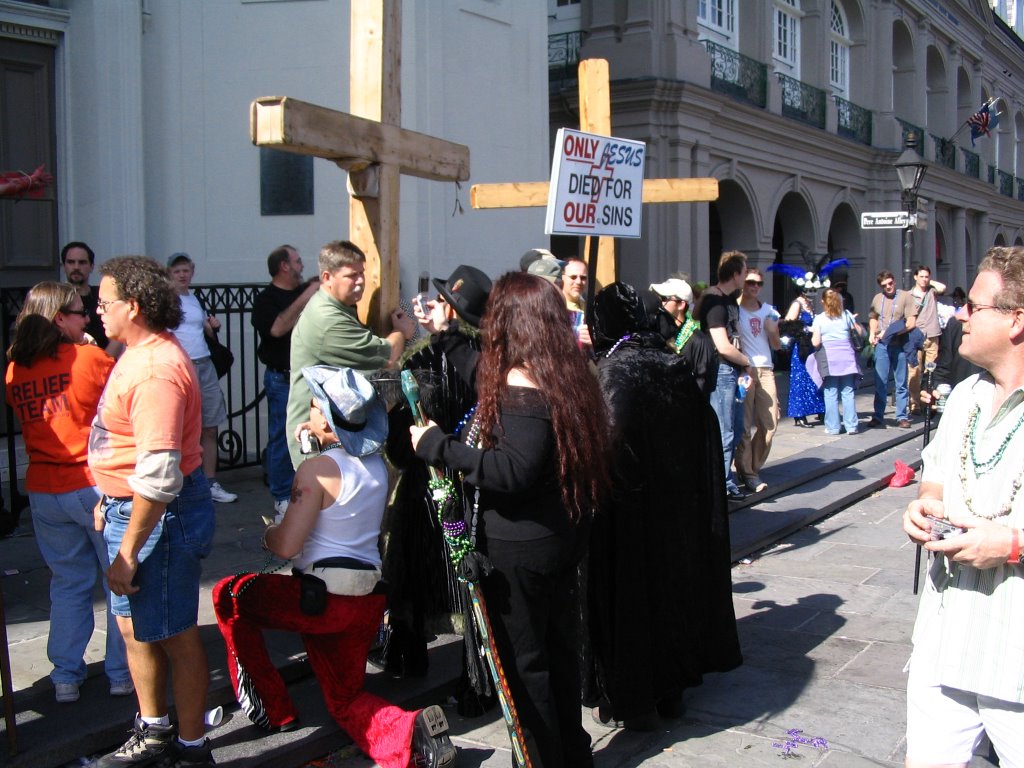
5.) Laughed at the Jesus Freaks in front of Jackson Square (and then felt bad about it. Damn my religious upbringing!)
Jackie filmed Jesus being put on a cross. He said, "Not too tight." I hope Jackie gets it to the Daily Show for This Week in God.

6.) Ate corn dogs.

7.) Danced alot.

8.) Waited in a lot of lines (albeit much shorter ones, this year) to pee.

9.) Smiled and laughed a lot. Smiled at other people's smiling.
10.) Felt good and whole for a while.

11.) Came home and felt tired and bad for a while.
12.) Woke up sad that it was over.

Mardi Gras is my favorite, favorite day of the year. It is really something everyone has to see. But don't come and watch--come and mask and come in costume. Even the oldest of men (and women) do! YAY!

Friday, February 17, 2006

As I drove Paul to the airport last Sunday, I was missing him already. I'd gotten to share a bit of my favorite time in New Orleans with him; on Saturday we attended the Krewe de Vieux parade that starts in my neighborhood and winds through the Quarter. Floats like the one that read, "Buy Us Back, Chirac," and, "Home is Where the Tarp Is" conveyed the "spirit" that journalists keep referring to (tritely, I might add, though not without truth). We laughed, we caught throws--my favorite was one mocking the power company, Entergy, with a likeness of its logo changed to read: "Entropy: We Have the Power... and You Don't"! Later that night, as if to ice the cake, the power went out. This time, though, it was charming.

Having Paul here was invigorating. Simon took him on a bike ride into the Lower Ninth while I taught, and when they returned, Paul seemed visibly shaken. "I was blown away," he said. I did my best to keep things light. When we went out later to tour Gentilly and Lakeview, I said that I thought it was good we were getting all the devastation packed into one devastating day. So on Saturday we could move on to some fun. We could move on to posting the Valentines his students made for New Orleans kids--the ones that I laughed at that said, "We Wish You the Best," and the one that read, "I Love You, Mom." We could move on to joking about the good a Valentine will do in times like these. 'Cause with someone from out of town here, you can make these jokes. With Paul here, they were funny.

But Paul is gone, and it is just us again, and as if to punctuate my emotional sadness, my body got sick and I spent Monday and Tuesday in bed, feeling sick and feeling dark. Last week's meeting has begun to sink in, and I really do have to think about what it will be like to live here without my teaching job. Sick and in bed, I began to feel like it's not something I can do. I've joked to others about driving a UPS truck, bartending at the Hard Rock Cafe--anything to stay in this city I so love. But really I'm not sure it's something I can do. Could I be happy without my students, without this life that I love? And with the city just a shell of itself--and that shell reminding me: You Are F-Ing Lucky at every turn--You Are F-Ing Lucky That You Are White, will I feel okay? Will I love New Orleans if she doesn't recover--if the people who made it the Chocolate City I moved to can't return? I'm just not sure.

But then Mardi Gras is upon us. On Wednesday we had cheerleading practice for the Ninth Ward Marching Band. The documentarians (everyone seems to be making documentaries in this city, these days) showed up even before the cheerleaders. They filmed me making buttered popcorn and arranging cookies on a plate. They asked me about moving here and what stories my students told. "What was the craziest story your students told," the cameraman asked. I couldn't remember. Weren't they all "crazy"? Wasn't THIS crazy--this standing in the kitchen that was still standing, buttering popcorn and talking about cheerleading and devastation in one breath--wasn't it?

I told the story that Debra from my class last semester told me. She'd worked at Gulf Coast Bank in St. Bernard Parish. She'd lost everything. No one had heard from the President of the bank, an elderly man who lived in Chalmette, and yet their first task was to rescue flood-damaged money from the back. They had to launder it. It smelled like flood and money.

I told this story, and then I said something like yeah, that was crazy, and I opened the 'fridge to return the butter to its place, saying, "I can't imagine. I've never had money to launder." And later--because this is how self-conscious and guilty I feel these days, I worried about how that might seem. Me, opening a full refrigerator, with its organic milk on the door, bemoaning my being the privileged poor. What could I possibly have of value to say?

And yet, in school this week I was telling my students that THEY ALL HAVE STORIES TO TELL. Many of them feel like their stories aren't worth telling--like stories like ours of survival and guilt and what it's like to be okay amidst everything that's not are not noteworthy. "All of it matters," I said. "All of it."

But really, when you feel like no one is listening, when you see the lack of change, the way things have remained and remained and remained as they were the day we came back in October (okay--there are more gas stations and grocery stores open, yes, but so what?,) it is hard to remember that everything matters. It is hard to remember that anything matters. When Paul was here, though, and when outside people come in, it feels again like we matter.

And when we parade--when we make up a routine in the back yard to the recorded band music: "Rock You Like a Hurricane" and "House of the Rising Sun", while next door the Hispanic contractors peek out from behind the plywood windows of the house they're repairing--when we listen to music and dance, not just to celebrate, but to forget, it's all good for a minute. For a Valentine's minute, it's all f-ing good.

Saturday, February 11, 2006

Our dear friend Terrence wrote this poem and read to me on the phone from Houston last night. It might be the best Katrina poem of all time.

"I Wanna Go Home" by Terrence Walton

I wanna go home.
A summer day has come and gone,
Texas is wrong,
I wanna go home.


Terrence's friend, Jabari, and Terrence next to our Loquat tree--or, as they call it, the "Misbelieve Tree" (no one seems to know why New Orleans children call the japanese plums Misbelieves, but they do, and I love it.) Our loquat tree is readying her fruits, but this year there won't be kids around to eat them.

I'll write more about Terrence and his famlily soon.

Wednesday, February 08, 2006

I have always been a good student, and I may be an even better teacher, but I have never liked school, in the social sense, and so my choosing to work in the academic system might be a bad fit. Once upon a time I had grand ideas of publishing and all that, but then I saw what it does to one's ego, and what one has to do to sell oneself, and I decided that being a really good teacher and maintaining a mediocre blog is happiness enough for me.

Still, hearing about the upcoming cuts at the University of New Orleans, and knowing that my being hired so recently (and for teaching lowly comp classes, at that) and not having published puts my job in jeopardy, I get edgy and realize that if I want this career, I'm going to have to do a whole lot that I don't want to do. Like attend really really log faculty meetings where tenured faculty say things and ask questions designed to disparage us lowly instructors.

Such was the scene yesterday at the Liberal Arts faculty meeting at UNO. I'd known about the meeting, but had forgotten, but my office-mate and friend Matt told me that it would behoove me to go. "They don't take attendance," he assured me, "but they notice who goes." So, in the interest of keeping my job, I went.

The meetings are held in a very large lecture room with stadium seating. One of the casualties of the storm has been janitorial services and apparently a key to the boiler room, so like the classroom I teach in, this one was strewn with candy wrappers, balled-up paper, and coke spills. It was hot, and extraordinarily stuffy, and the projector screen had been pulled down to conceal the missing bottom portion of the wall. Ah, the halls of the academy.

We'd heard that this would be The Meeting where they told us about the University's future, and the Chancellor was scheduled to arrive at 1:00. The dean of Liberal Arts thanked us all for teaching online in the fall, for continuing to do so while the school restructures its course offerings, and commented on the lack of housing for displace students and faculty.

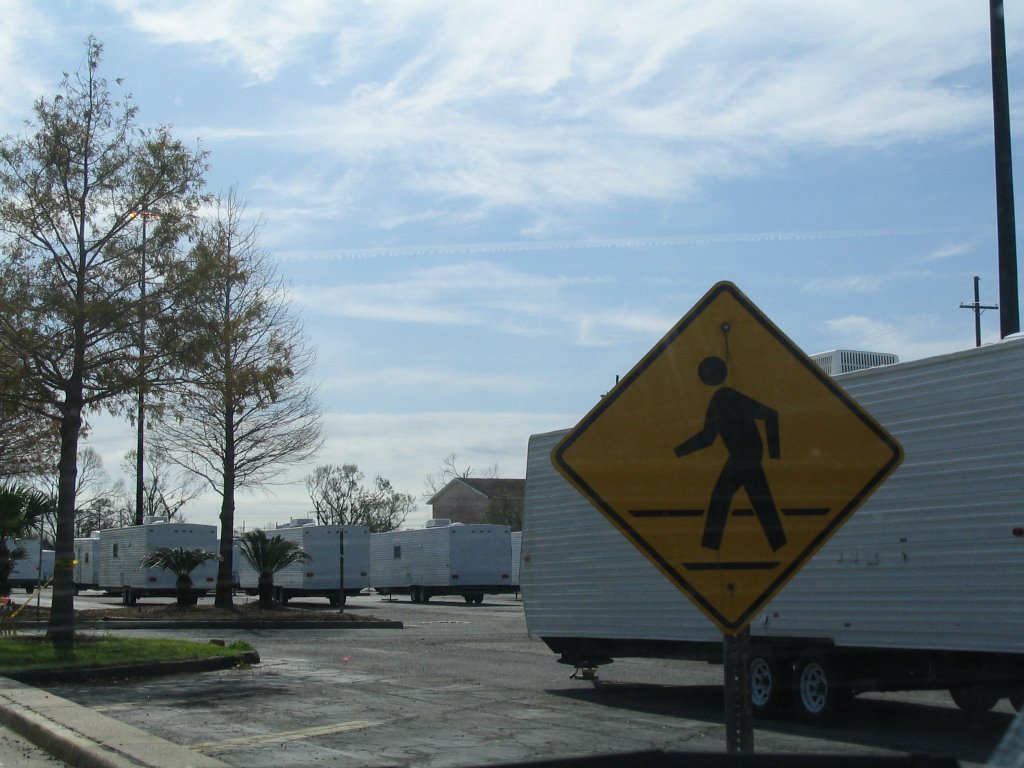
There are two large FEMA trailer parks on campus--one on the Quad next to the student union, and one in the parking lot by the London Canal. Neither park has inhabitants, but both are guarded by someone in an SUV with tinted windows. The trailers were promised by November and then December and then January and most recently February, but nothing has changed. Not a single trailer has been hooked up to power or water sources. And no one knows when they will be. "I don't believe a word FEMA says," Dean Krantz told us. And we all nodded, knowingly. It is exhausting, this fatalism. It feels awful not to matter to the powers that be, and to know it. This is what that feels like. I now know.

But the trailers evidently cost an average of $35,000 EACH just to hook up. And the state has to pay 10% of that back. And we are a state-run school, as is LSU, who has been lobbying hard to get more money while we are "down." It has always been this way. LSU wants to be a flagship University. It wants UNO to fail. But to lobby for money in these times (in these times!)--blatant greed, the Chancellor called it. So LSU is lobbying against us and we are lobbying to get help and the state is hedging its bets and wouldn't it be better to just let us flounder so they don't have to pay back these ridiculous fees? Isn't that what is important--the money? I mean, screw having a research University in New Orleans. Screw 'em all, right? Survival of the f-ing fittest. God, it makes me sick.

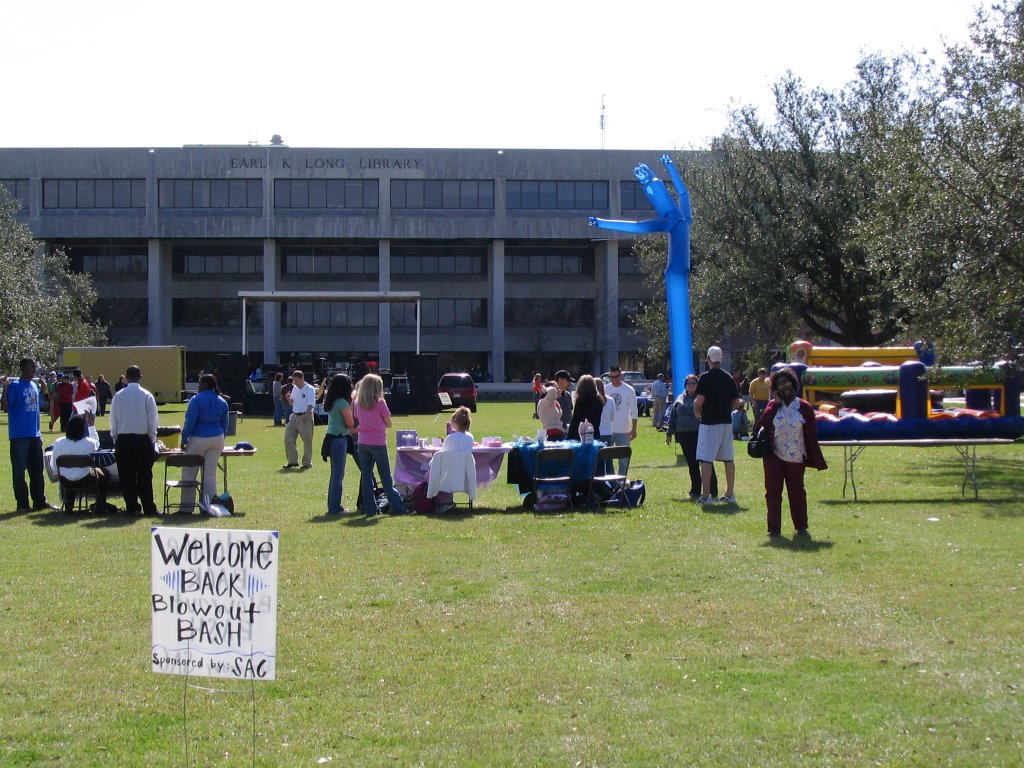
So chancellor O'Brien arrives, and he is NOT my favorite dude. He's a business man, after all, and he's responsible for the ridiculous over-investment in UNO's business program (and, surely, for the inflatables at every UNO gathering,) but he is a good dude to have on our side right now. He seemed genuinely angry and genuinely worried for us and as if he genuinely cared that many of us will be losing our jobs soon.

The timetable is one month. Over the next month the University will do what Tulane did--it will restructure, cutting out certain programs and firing where needed. I think my job is as safe as they come--they'll always need comp teachers--but only if the enrollment numbers come up, and that is highly unlikely. Most of our students came direct from New Orleans Public Schools, and with no graduates this year and at least half of those students gone, who will come to UNO? So event though comp is a safe place, it's still likely, I learned, that I will be out a job come summer.

O'Brien kept saying, "waste and frustration" when he referred to The System, to trying to get money from the Feds. And I think a lot of folks probably read about New Orleans right now and think that we are a waste, that we should be frustrated, that we should take care of our damn selves. Well, as our Dean said yesterday, we simply have to stop acting like what happened to New Orleans was inevitable. It was not the hurricane that hit us, it was the flood, and the flood was a man-made disaster caused by years of waste on the behalf of the federal government. I grind my teeth when I think hard about it, and then I have to stop because I need to keep my head focused on the daily.

And that's what I will keep doing: I will be a damn good teacher, and maybe a better girlfriend, and I will take my evening walk past the hooting contractors and the piles of debris, and I will ramble on this blog because it is good for me, and I will take pictures of the things that just don't make sense.

Wednesday, February 01, 2006

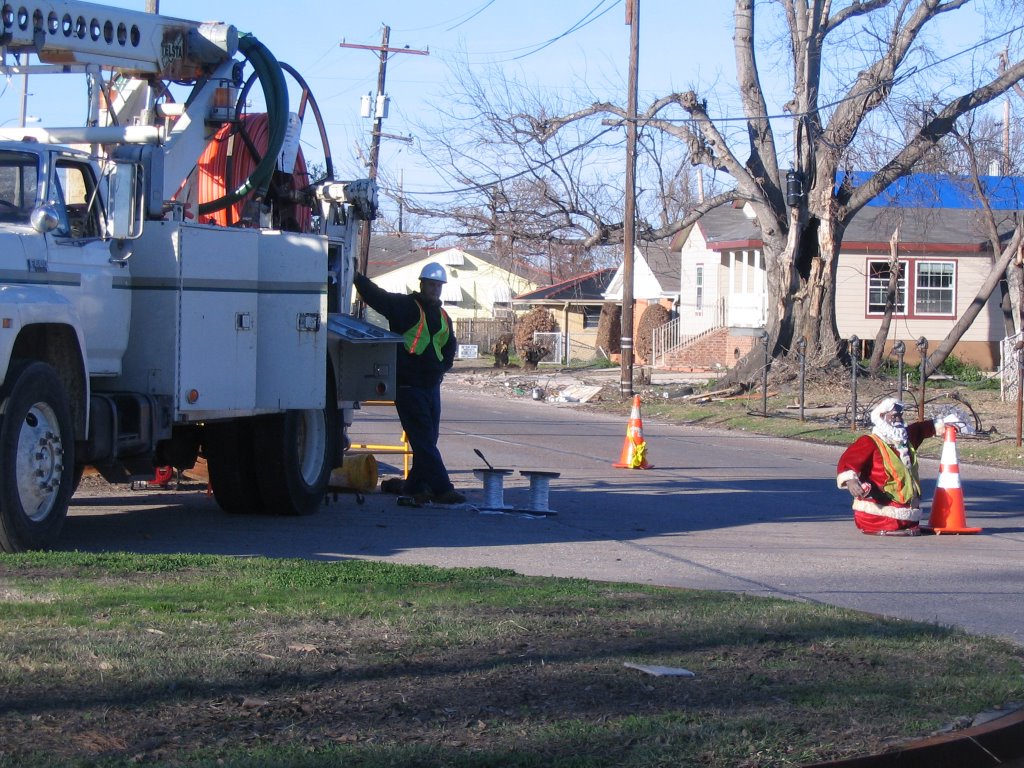
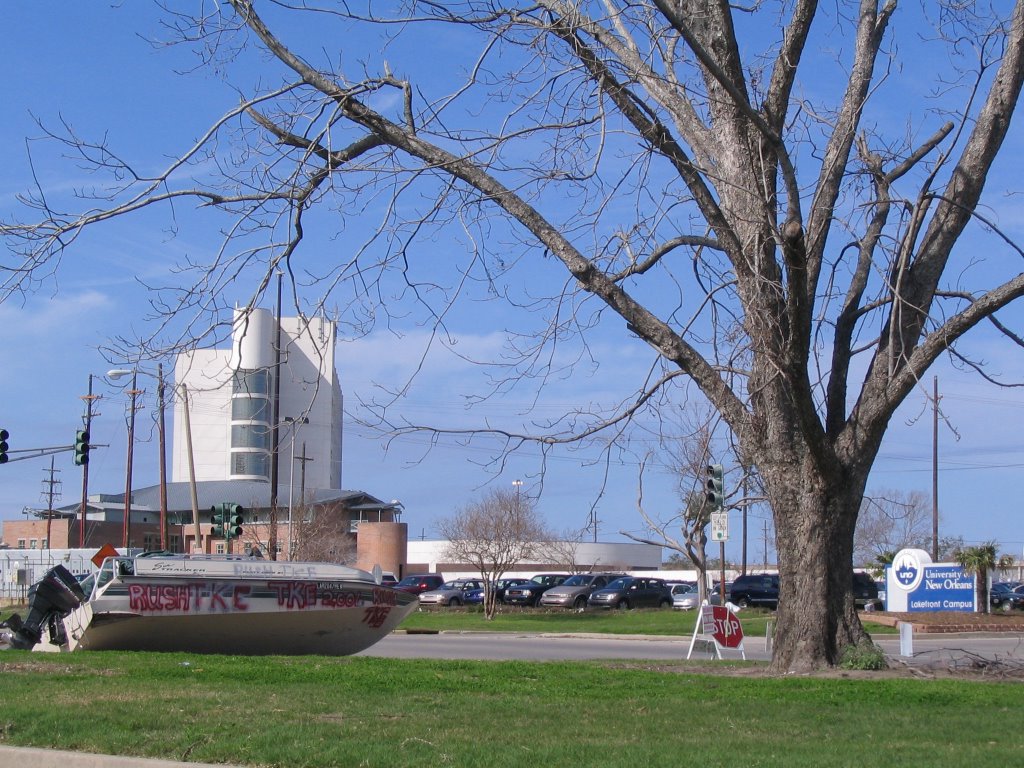
So I am overjoyed to be back in the classroom--even with my horribly crappy schedule. I took some pictures from my drive to campus and some images from around campus. The one of black Santa and the worker is on Franklin Avenue, the road I drive to work every morning. I found the stranded boat spraypainted with a call for Greek pledges somehow uncanny. Next to the student crosswalk from the parking lot to the campus buildings is a FEMA trailer park that sits, unused. And finally, no UNO party would be complete without money wasted on stupid inflatables. On to my post...
Reading back, I realize that many (okay, most) of my recent entries (all right, all of them) have been, well, depressing. I worry that I'm injuring the reader (my mom,) and that harping on the negative will cause my reader(s) (my mom) to turn away. While I want my readers to empathize, I don't want to injure them.

In a class I once took in graduate school about literature of the Vietnam War, we talked about trauma and recovery. It is impossible, our prof said, to recover from trauma if the listener cannot listen without injury. I thought that was a fluke. How can we truly empathize without feeling injured?

At any rate, today I will share a bit of hope in sharing with you my return to teaching at the University of New Orleans (this in spite of the fact that the President's State of the Union Address was an abomination worth a blog unto itself... our local news has New Orleanians reeling about the mere 36 seconds spent on New Orleans, the lack of any new rebuilding plan or commitment, the absence of appropriate reverence for the 1,000+ dead; Simon reminded me that it was politically relevant for him to eulogize the dead in his speech after 9/11. Ours would be better ignored from a political standpoint.)

Whoops. That was anger.
Moving on...

School has started, and I get goosebumps in the classroom and am nearly brought to tears by the posts of some of my students in my online classes. Here are some excerpts:

"Hi everyone, my name is Kristen Johnson. I’m currently staying in Georgia with my parents, siblings, and boyfriend. Long story short, my house in Louisiana has to be rebuilt so I’m living here for now..."

And:

"My name is B__. I am currently a graduating senior at UNO. My major is Hotel/Restaurant/Tourism Administration in the College of Business. I am fortunate enough to still be living in the metro New Orleans area because my house did not recieve major damage. My heart goes out to the many that did though. I work at the front desk at a hotel downtown which has re-opened, even though we had 5 feet of water in the lobby. (and looking for employees if anyone is interested!)"
And:

"Hi all. My name is M__ and I am a senior majoring in Psychology. I also have a minor in business management. I am originally from the West Bank. I graduated from Brother Martin in 1999 and hope to graduate from UNO this fall. I was currently attending UNO when Katrina hit. I was lucky enough to get into LSU and find a place to stay in Baton Rouge. I just recently came back to the city, and I am in the process of moving into a town home uptown.

I am also a member of the 159th Louisiana Air National Guard Unit. If you guys ever pass through uptown and see the soldiers in the humvees…that’s us. I also bartend at the Venue, so if your ever in the neighborhood come swing by. Finally, and certainly not least, I receive all my joy from my 3 ½ year old son, Tyler. He is a spitting image of me and his favorite books are pretty much anything pop up!

I’ll have to admit I have a terrible time finishing a book front to back in less than a 8-10 month period. But needless to say I really enjoyed Tolkien’s Lord of the Rings Trilogy. I even delved into his Silmarillion a bit. It was mostly for the background. I also like Tim O’Brien’s If I Die in a Combat Zone and John Barry’s Rising Tide. Rising Tide was particularly interesting because it was basically a crash course on the Mississippi River, the flood of 1927, and the politics behind it all.

My hobbies include hitting the gym about 5 times a week, spending countless hours on the internet, playing with my son, and enjoying time with my friends. Even though UNO is not the same I am very glad it is back up and running."

And my favorite:

"My name is Yvonne but all of my friends call me Alexis. I was born in New Orleans and my family has always been here but I've lived in different parts of the southeast. I am 19 years old and I have been out of high school for 3 1/2 years and now is my first time in college. I homeschooled myself my junior year, which allowed me to complete two years in one and graduate early. I then left home, started to work full time and joined a band. I love to travel, sing, read, write, play, listen to music, appreciate art and history, work out and hang out with animals. I have two rokken little dogs- Lady Death Dog of Doom, a 3 year old papillion (9 lbs) and Lord Korsan, Champion of Terror, a Parson Jack Russel Terrier who is just a 9 week old puppy coming in at 5.6 lbs! My family's houses were in Lakeview and my apartment was in mid-city so Katrina pretty much ruined my life. Now I live in a FEMA trailer in Metairie and the state of my city makes me sick. Some days I feel like I'm living in the ghost of what my life used to be, especially when I drive to the UNO campus because Lakeview is so dead and it used to be so alive. Anyway, I am just grateful to be in school because education is freedom and freedom is life."
'Nuf said.

Monday, January 30, 2006

While I don't have permission to reprint the following editorial from today's New York Times, I want to share it anyway. It's a nice companion, really, to my previous post about becoming used to a new "norm"--one that no one should have to become used to. So, here it is:

January 30, 2006
Editorial

Louisiana in Limbo

"New Orleans waits. While some heroic efforts at rebuilding are taking place, hundreds of thousands of residents have put their lives on hold until they know what the government's next steps will be, leaving the shells of their houses as placeholders. But the Bush administration has now rejected the most broadly supported plan for rebuilding communities while offering nothing to take its place.

It has been five months since Hurricane Katrina struck the Gulf Coast and for many the norm is still the claustrophobic new reality of tiny trailers and multiple families crammed into single apartments. Louisiana is trying. You can hear jackhammers pounding and buzz saws whirring on Canal Street in New Orleans. Dedicated workers endure a grinding daily commute from points north, like Baton Rouge, as they try to make the city and the region whole again. But the mission is far from complete and the challenge is beyond the scope of a broken city and a poor state.

New Orleans's crisis has little relation to anything the nation has faced in modern memory, and traditional solutions will simply not help. Homeowners — many very poor people whose houses had been in their families for generations — had varying degrees of insurance before the disaster. When entire neighborhoods are devastated, their mildewed furniture and drywall piled on the roadsides, it's impossible to tell the people who are well insured to rebuild and hope that the houses all around them will somehow be reclaimed somewhere down the line.

But the Bush administration refuses to support the plan of Representative Richard Baker, Republican of Louisiana, which would give everyone the capacity to rebuild and which had the backing of the mayor, the governor and the state's Congressional delegation. (To add insult to injury, two days after the White House shot down Mr. Baker's proposal, President Bush suggested at a news conference that Louisiana's problem was the lack of a plan.)

Instead of an alternate solution, the president's Katrina czar, Donald Powell, has offered sleight of hand, touting $6.2 billion in development money for Louisiana passed last year by Congress as if it were somehow a substitute. And in an attempt to narrow the scope of the problem, Mr. Powell says the government first needs to care for the roughly 20,000 homeowners without flood insurance who lived outside the federally designated flood plain. The real tally of destroyed or damaged homes in the region is well over 200,000. And the real need is housing for residents, whether they were renters or owners, insured or uninsured, living above the flood plain or trusting the federal government's levees to protect them from storms.

Perhaps too much emphasis has been placed on the wreckage of poor, low-lying New Orleans neighborhoods like the Lower Ninth Ward. That has sparked the unproductive, blame-the-victim debate revolving around whether people should have lived there in the first place. The Ninth Ward provides a misleading picture of the city, as do the relatively unscathed tourist areas like the French Quarter and the Garden District. Huge swaths of the city have the empty quality of a ghost town. Stores wait for residents to reopen; residents wait to see if neighbors will return. The city and surrounding parishes will not meet Mr. Powell's neat categories, when renters lived beside owners, insured next to uninsured. He is talking like an actuary when a leader is needed to rescue this region.

Now, Congress has a responsibility to follow its own lead rather than the president's. We were outraged once, shocked at the images on our television sets, at the poverty in our collective backyard and at the devastation of a great city. As the disaster threatens to become permanent, we have every reason to remain so."

Saturday, January 28, 2006

I am tired of writing about aftermath, and sad that there is one.

I cried over it this morning. I hadn't cried about it in a while. I was reading this article in the Washington Post, called "Post-Katrina Promises Unfulfilled," and got to this part:
"Beyond levees and housing, the region faces other huge challenges, Powell said, including jobs, schools and health care. One in every five Louisiana prime-rate mortgages is 30 days or more past due. One in six adults is unemployed. Only 15 percent of schools and 32 percent of hospitals are open in Orleans Parish, and one in three grocery stores and restaurants in the region are open."

And I realized that while I hadn't known the numbers, this wasn't news to me--that I'd grown accustomed to it, in fact--like my pre-Katrina, fatalistic self.

It is so easy to become fatalistic, though, when you are reminded, repeatedly--by the lack of response from the government, by the lack of change, by the daily-ness of making things happen in a city that still doesn't work--that this city will never be what it once was.

It is easy, too, when you know that most people out there haven't a clue, and frankly, don't much care to.

I have grown accustomed to the change. To the lack of change.

What does that say about who we are, as a country, and who I am, as a person, that those who don't live here have stopped caring, and that we, who do live here, have learned to deal?

In fact, so much of this aftermath has become like wallpaper. Wallpaper isn't the right word for it. I can't describe how it feels, really, to become used to a city in this state.

The news, the ads, the billboards--are all about rebuilding. There is a channel on cable devoted entirely to slide shows of devastation. There is my drive to work, where I am annoyed, now, by endless construction and orange cones. There is the way in which we avoid talk of homes and futures, particularly around our friend, Kim, who lost everything and has picked up smoking again. There is our anger, which has grown old and barely registers, these days. There is the banging, in the morning (and all day), of Mexican contractors repairing next door. My soundtrack. My alarm.

And still. I love this city like I can't even say. And I hate my president for lying. Again. God help us!

Thursday, January 26, 2006

After being assigned what is surely the worst teaching schedule I've ever been assigned (three comps, two online courses, a lit course I've never taught before, and four separate preps,) I wasn't in the mood to get the following email. The email is in reference to the hundreds of displaced UNO faculty, staff, and students--among them, my dear friend and colleague, Kim, who lost her newly-bought Gentilly home. As I've mentioned before, the areas surrounding UNO are devastated. Nearly entirely. The drive to campus is chilling. And here I was whining about my schedule.

I was preparing a syllabus when the email came, and I read it out loud to Simon. We laughed incredulously, 'though it made me feel more like crying (one has to find alternatives to that if one is to stay sane.)

This email demonstrates the abomination that has been FEMA's response to Katrina. That the University of New Orleans--on the eve of a new semester--would have to send out a plea to its own alumni and faculty to house its own----!!!

Incidentally, FEMA has continued to call me and offer assistance EVEN AFTER I withdrew from the housing assistance program. (We'd returned to New Orleans and learned that our home was okay, so we withdrew. So we're not all leaches or low-lifes as the media may have you believe.) They have also offered trailers to friends whose homes were unscathed, while others whose homes were destroyed have waited and waited and continue to wait, still. This is five months after Katrina.

But, BEFORE I SHARE THIS EMAIL, I want to say that I worry, dear readers, that you will turn your backs on us--that you will read about the disaster that is FEMA and the clown that is our mayor and decide that we are not worth the nation's money and effort.

WE ARE! And we need you now--five months later--more than ever!

So here it is: the email that I CANNOT BELIEVE I received:

To: UNO Faculty, Staff, Students, Alumni, and Friends of UNO
From: Bobby L. Eason, Ed.D. Assistant to the Chancellor
Date: January 26, 2006
Subject: We need beds

The University of New Orleans needs your help. We want you to consider opening your home to one or more UNO faculty/staff/students (FSS) for a brief period of time.

Here is our plight. As promised to us by FEMA, trailer housing was scheduled to arrive in January for UNO’s displaced faculty, staff, and students (FSS). They have been delayed. We turned to “bridge” housing in hotel rooms, again recommended by FEMA. Now FEMA will not allow hotels to accept UNO FSS under the reimbursement program. We are appealing this decision to the highest level. In the meantime, many of our FSS do not have a bed for sleeping and school begins this Monday.

If you want to help, please respond immediately to the following:

I will accept one or more faculty members in my home (indicate how many).
I will accept one or more staff members in my home (indicate how many).
I will accept one or more students in my home (indicate how many).
I will accept a combination of faculty, staff, and students in my home (indicate how many and what combinations).
I am aware that student trailers will be ready late February and faculty/staff trailers late March. I am willing to have a UNO guests(s) in my home for (one week, two weeks, three weeks, four weeks, as long as the need exist, etc. Let us know how long your bed will be available.)
I am aware that some of the FSS have families. (Let us know your preferences, e.g., single persons only, husband and wife only, families with children O.K.)
Please indicate any restrictions that you wish to mention. (I am interested in non-smokers only. Smokers O.K., but must smoke outdoors. Smokers O.K.) All guests that smoke will be instructed to smoke out of doors.
I am aware that some individuals have pets. (Indicate your preference, e.g. I will accept guests with pets, it depends on the pet, no pets please.)
I am aware that many FSS are international. (I prefer international guests. I prefer traditional U.S. guests. I have no preference.)
I will open my home for a bed, but I will need some level of monetary compensation from my guests to defer utility and other expenses. (Please answer in any way that you wish.)
I am aware that meals are an issue. (I will provide a bed, but not food. I will provide a bed and meals. I will not provide meals, but will provide kitchen access. I will work out the meal situation with my guests.)
I am aware that some FSS may not have transportation to UNO. (I will be able to provide partial transportation to UNO. I will not be able to provide any transportation. I will discuss transportation with my guests.)
Indicate any other concern or restriction that you have.
I want to provide beds, but there are times when my guests must find other places to stay because of extenuating circumstances (leaving for Mardi Gras, have other guests coming in from out of town, etc.—please indicate)
In addition to above, if you are willing to share one or more beds, please provide the following:
Name ___________________________________
Phone ________ ___________ __________________
Cell phone ________ ___________ __________________
E-mail ______________________________________
Address ______________________________________


f. Other ______________________________________

Please e-mail, call, or personally contact Bobby Eason. Also, we have established a Temporary Housing Help Desk. Call (504) 280-5447 or 280-5428 (they do not roll over.) My direct phone is (504) 280-6874. My e-mail is bleason@uno.edu. You may submit your information in any form. I am located in room 2000 Administration Building if you want to drop it by.

This SOS is our last resort. We regret having to make this request. Yet, we appreciate your consideration of this crucial matter.

****
Wow. And these guys were at UNO--along with the national news--not long ago.

If only they were here now. I have a feeling that if they were, this email--this SOS--would be unnecessary. When the media forgets us, the government has a way of doing the same, too.

Monday, January 23, 2006

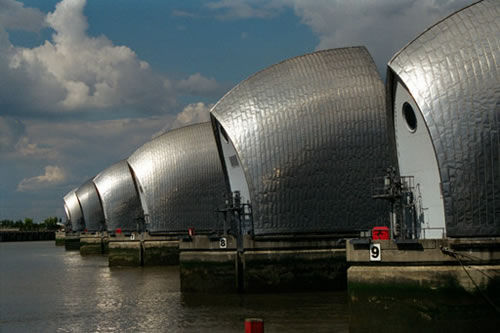
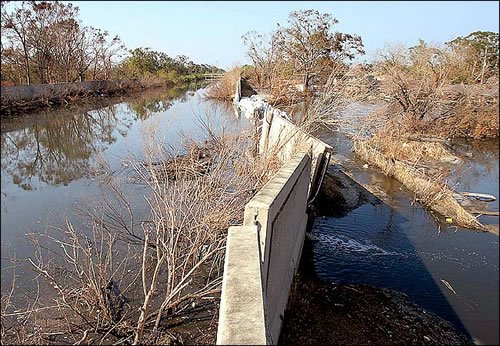
Their Levees vs. Our Levees

I found these images on the Common Dreams website. While I am surely violating some sort of copyright law in republishing them here, I am going to go with the Common Dreams disclaimer and chalk it up to education. One need only glance at these images to come to startling conclusions about our nation's financial priorities:

The British protect the city of London this way:


In Venice, the Italians hold back the sea like this:


The Dutch, whose population, like ours, lives mostly below sea level, protects its citizens with levees like these:


And us? The United States--a country wealthier than any of these, "protects" the citizens of New Orleans (a city long known to be threatened by flood) this way:


Yes, U.S.A., we're number one!

Wednesday, January 18, 2006


It's official: our mayor has gone bonkers. And if ONLY the results of his MLK-Day speech were as amusing and harmless as this feature on Nolafugees.com(a MUST-READ), or as Chris Rose's column in today's Times-Picayune. Unfortunately, his calling New Orleans a "Chocolate City" has given every closeted (white) bigot permission to out themselves publicly. One need only read a few of the letters submitted to Nola.com in response to his speech to see that white New Orleans is piping-mad. It feels to me almost as if these people--these reactionary people who cannot call a dumb speech when they hear it--are HAPPY to be "free to be racist" now. Hoo-F-ing-Ray!

Oh, C-Ray, What the!?

You really must read it to believe how utterly foolish and ill-advised this speech was. And I am someone who WANTS this to be a "chocolate city."

Last Friday, during one of our periodic blackouts, Simon and I took a moonlit, midnight stroll through the neighborhood, and I stood at the corner where Terence and Gaynelle once lived and started to cry. "We'll never have black neighbors anymore," I said.

It's true. It's a real fear. With rents in the city averaging $1,200 (for even the smallest apartment), one would be hard-pressed to find black residents able--nevermind willing--to return. If Simon and I didn't already live in an undamaged house with affordable rent (and friendly landlords,) we, too, would be screwed. It's the poor--and yes, even the privileged poor--who can't live in this post-Katrina city. This city that once belonged to them... to us.

And that's what makes ME piping-mad at all of the property-rights a-holes these days. It is NOT the property that matters now, it's the people.

Oh, and the FOOLISHNESS coming out of everyone's mouths in response to this dumb, dumb, dumb speech of the mayor's! In addition to the threatening letters on Nola.com (where white tourists and evacuees threaten to take their "vanilla money elsewhere," Senator Lieberman said he'd been talking to Senator John Breaux and that they'd like to point out that "there's dark chocolate and there's white chocolate." Puh-lease.

The mayor, too, tried to wash away the damage with some bullshit "chocolate milk" story: when he was a boy, he used to mix the chocolate syrup in with his (white) milk and get a beautiful, delicious brown.

Again: puh-lease.

Mr. Nagin, you said that God wanted New Orleans to be a black city--and you are free to say that! And free to mean it, too! But don't--please, please DON'T--blame it on some milk-and-cookies rhetoric. Call it what it was: a dumb thing to say that, nonetheless, was based on real concerns that this city may lose the black residents--and culture--that made New Orleans, New Orleans. Why can't the man see that now that he's SAID it, he could actually make something productive come out of it? He could start a REAL DIALOGUE about race in the city. Instead, he apologized, he bullshitted, and now we look dumber than ever, and racial tensions are worse than ever.

I wish Mr. Nagin's speech had gone something like this, instead:

My fellow citizens, evacuees, relief workers, contractors, and lovers of New Orleans, I stand before you on the day we commemorate the life of the great Reverend Martin Luther King, Jr. a worried man. I worry that we will lose the culture that has defined this city for centuries. And I worry that those who have the power to stop that from happening don't share my concern.

The great racial diversity that made New Orleans the cultural gem that it is today--or was before Katrina--is now at risk. The black population--a population born of free blacks and Creoles--bore the overwhelming brunt of the devastation, and now we face the daunting task of convincing the rest of the country that these displaced residents are more than just "those people." Because it seems that the country--and maybe even some of you--thinks that this city is better off without them. I remember in the days immediately following Katrina the images that the whole country saw on their screens were those of black people--black families, black children, and our black elders--but what the media chose to focus on was black looters. Our black residents became "Those People"--those criminals, those refugees, those helpless, hopeless New Orleanians. It's no wonder that the country--and that Barbara Bush--thought Those People would be better off somewhere else. And some of Those People--some of US--may, in fact BE.

Which is why I stand before you, pleading, asking that you imagine a New Orleans that Martin Luther King might have. Imagine a New Orleans in which Those People are Our People. Imagine a city in which Our People own homes--insured homes--homes above the flood plain. Imagine a New Orleans in which our people are not dependent on decaying public housing and federal handouts. Imagine a New Orleans in which ALL of us could provide for ourselves. In this New Orleans, rivalries between warring factions wouldn't exist. In this New Orleans, a second line would truly be a celebration of life, of coming together, not a battleground for the despair and anger that is borne of poverty. In this New Orleans, we would see that poverty and despair are not just Their Problem--they're Our Problem. And in This New Orleans, the one we MUST imagine if we are to make it a reality, we would work not just for ourselves, but for Our New Orleans--for each other.

We can have this New Orleans, but we cannot have it unless we--the privileged few who have the resources to return and to rebuild--take it upon ourselves to help others. We can have this New Orleans if we recognize that those Others are Us.

...And so on and so forth (I'm tiring of the glossy rhetoric. I feel these days like a Speech is a Speech is a Speech, anyway.)

I'll say this: I moved to New Orleans partly because it IS a Chocolate City, and I'll stay only IF it remains one.

Monday, January 16, 2006

The topic of conversation these days is: "What do you think of the mayor's plan?" His plan is one that was released by the Bring New Orleans Back Committee last week and its most controversial element is a four-month moratorium on building permits in the city while neighborhoods are assessed for viability. It is the responsibility of the residents, themselves, to organize and lobby for funds and resources to be appropriated from federal funds following the four-month period. If residents prove their neighborhoods are "viable" (and no one seems to know what this means,) the city will consider its case as it goes about the next step of planning. The goal, it appears, is to reduce the city's "footprint," which will mean that homeowners and residents in certain parts of the city will have their property bought out by the federal government and then awarded to developers for "commercial or industrial use," or possible transformation into "parks and greenspace."

I don't know what I think about the mayor's plan, but I know I don't share the opinions of many of the business and homeowners who are now up in arms about the possibility of having to sell. To tell you the truth, I am SICK of hearing property owners talk about property rights. It would be one thing if these owners were refusing to sell or to budge in a rural area, but this is a CITY, and in order to sustain a city in the aftermath of severe devastation (and with a projected population just half of its previous size,) compromise is crucial. I am even more sick of listening to the city council members--all of whom object to the BNOB committee's plan, but NONE of whom has a better option to propose.

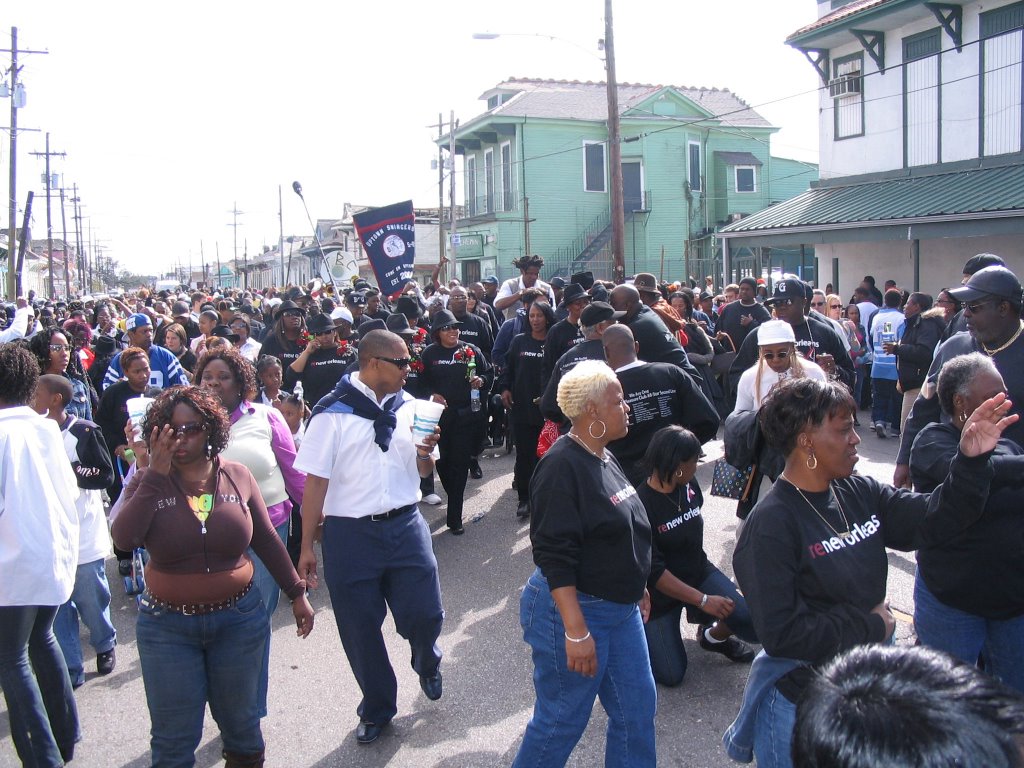
What I do know is that the racial tension in New Orleans continues to increase. Yesterday, Simon, Jackie, and I attended a second-line (a brass-band parade in which the participants are members of various "Social Aid and Pleasure Clubs" and the public, itself,) and for the first time since the storm, we, the whites, were outnumbered. It felt good. Like old times. But then I heard comments like, "They're trying to take our city," and, "White bitch better get out of my way," and I knew, I just knew, that this plan of the mayor's is going to exacerbate already-hot racial tensions in the city.

The problem is one that Sharon White, a woman from the Lower Ninth Ward who has been interviewed on NPR over the past several months, highlighted in her latest interview. She said that the members of the committee were "doctors and lawyers," and couldn't understand her neighborhood. She didn't say the members were white, but she didn't need to. The members of the committee ARE mostly white. And this is a real problem.

It is not that the committee members don't have the citizens' best interests in mind; the problem is the perception that because they are white, they don't care about the fates of the mostly-black residents whose futures they are considering. I think the committee f-ed up, big time, in not better incorporating the voices and opinions of the displaced and disenfranchised New Orleanians who were most heavily impacted by the storm. And now we will ALL pay for that mistake.

I remember going to my very first second-line, way back when, and knowing that it was really something special. It seemed like all of the racial tensions, the class tensions, didn't matter for a few hours. We all just danced, danced, danced.

Yesterday was no different, except this time, I heard comments that made me swallow and move on, move on. And then, later, it was different because shots broke out and three were injured.

When it happened, we were eating sandwiches near the Zulu club on Orleans, when suddenly, a crowd turned the corner, fear in their faces, sprinting toward us, toward Away, away. Jackie, Simon, and I crouched and pressed ourselves against the wall of the building behind us, trying to live and be out of harm's way.

And all of us, everyone, I think, just hoped and hoped and hoped that things would turn out differently than they had--that it would be the beginning of the parade again, and we would be dancing and celebrating our being together again, the evacuees, returned, wearing shirts that said, "ReNew Orleans," or matching outfits, or waving feathered plumes. We were nostalgic for a time that, maybe, in fact, never really was.

Friday, January 06, 2006

Once upon a time there was a lovely little truck that rolled through the neighborhood each day. Its driver was an old farmer of a man, who sang-song on a megaphone a list of his wares: "I got oranges and bananas! I got grapefruit! I got me-lons!" It was my morning alarm, and a sweet one at that. It made me roll around and stretch and yawn and smile to myself; it was that charming, the fruit man's truck. One time (and only one time,) I was awake when he drove by, and so I quickly got dressed and ran out to get some fruit, but he'd gone already. I ran four blocks to find him. I bought lemons. A strange choice, yes, but highly useful in one's cooking.

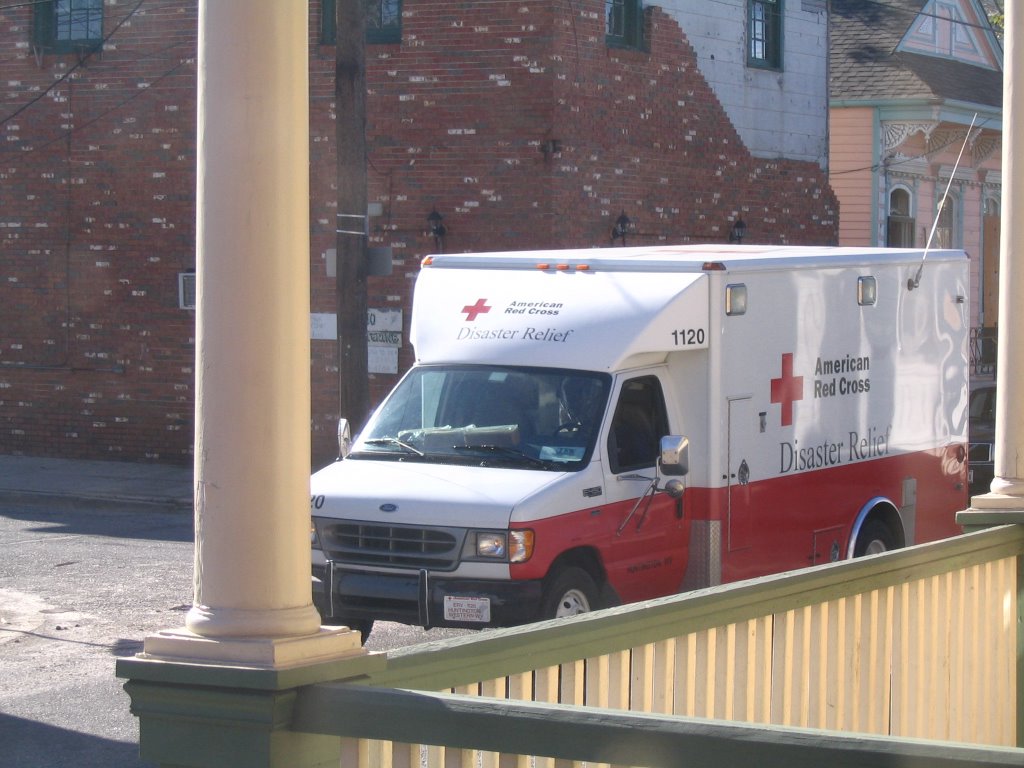
Now it is the American Red Cross truck that trolls the neighborhood every day, and it is a charmless, annoying thing to hear. I know I've mentioned this truck before, but you must know that this wretched vehicle accosts me daily. Its horn is identical to a cop's horn, and it stops just two houses down to announce over a loud speaker,(BRANK-BRAANNK!!) "THE AMERICAN RED CROSS HAS HOT MEALS AND WATER!" to contractors and workers and folks who, as far as I can tell, are just fine, thank you; perfectly okay.


The ARC truck had its charm once, too, but that was months ago, when we had first returned--when stores weren't open and there was only one place on town to get gas; when everyone's refrigerator contained a fermented potion of eight weeks' worth of rot; when there was no gas to cook with, and often no electricity. Yes, even though we had money with which to feed outselves, one day, Simon ran out and got us a couple of ARC meals: formed chicken-part patties and canned peas floating in a puddle of green water; a hard roll; a sachet of mayonnaise. We were disappointed. When we'd worked as case workers at the ARC headquarters in Atlanta, the meals had been enormous catered affairs: one day a Mexican feast, the next, an elaborate BBQ spread. The meals the trucks here serve seem only to remind you that things here are far from normal. And now, so, too, do the trucks, themselves. Each day I hear that horn, that announcement over the loudspeaker, and I remember that this is a hurricane-ravaged city we're living in, folks!

I know that these meals are helping people in need, and that it is easy to criticize from a position of (relative) privilege, but I do wonder what the ARC volunteers think--feel--when they drive through our neighborhood: the beautiful (and intact) houses painted shades of Easter eggs; the residents with laptops using the local coffee shops' (all three of them) WiFi; the gay homeowners out sweeping the sidewalk to music piped from their remodeled homes; the "free living" punks cruising on their vintage bicycles to the next protest--do we seem to be in need? Do the volunteers feel, as I do, that their efforts are being misspent in our neighborhood, that we might, in fact, be better off if they left for areas that really were hard hit, or, in fact, if they left, altogether?

What we need is housing, jobs, and education, as a woman in charge of the Central City Community Council said the other night. We needed the food a long time ago, in those days immediately following the storm when the Red Cross was staying away, protecting its own. Now, it seems like a colossal waste of money--money given by the American people, who would, surely, agree that it should go to the areas of greatest need. The Marigny/Bywater is not one of those areas, and the trucks, these days, do little more than feed the otherwise well-fed, serve up a degree of Post-K novelty.

I have mentioned this before, but if you would like to give money to an organization (and we do, in fact, badly need your help,) please consider giving to another organization that is serving our current needs. Habitat's Operation Home Delivery is a good one. So is Common Ground. Or, you can check out a list of non-government organizations helping in the Katrina recovery effort. Most importantly, perhaps, is that you write letters and stay interested in what's happening here. You can start by signing a petition for levee board reform. Whatever you do, please, please DO it. I mean, I hope you find the blog, um, fun to read, and all, but I'm telling you what it's like to live here because I need you to help make it a more livable city.

Word.

Monday, January 02, 2006

Happy New Year

The holidays have passed, taking with them any excuse I may have had for my loafing around, reading, and generally being useless. I remember once upon a time, in those harrowing first weeks after the storm, I planned to do Great Things. I would come back and volunteer and clean up and work, work, work like crazy to get this city that I love so much back on its feet. Instead, I find that I am suffering with a bad case of the blues, and like many other New Orleanians who have returned, I deal with this by a) sleeping too much b) fawning over my cats c) contemplating writing (and rarely doing it) and d) drinking at least a few times a week.

Now, lest my mother read this and begin to worry that I am showing symptoms of those addictive D__-genes in my family, let me say that I am not an alcoholic (seriously, I mean it,) and that, all things considered, a little bit of the blues is to be expected. I wouldn’t call it, “Wigging Out,” as this article does, but one does get the feeling that one has gone a tiny bit crazy when one lives in a Post-Katrina New Orleans.

Luckily we are in our home, which, while mostly undamaged, does appear to have taken some water, which I discovered while cleaning behind the toilet in our bathroom. A strange brownish-gray film, much like the one that covers, well, everything, in other neighborhoods of NOLA, covered the back corner of the toilet’s pedestal. I wiped it, and, uh, smelled it, and it had that unmistakable and indescribable odor that has become so familiar. Upon closer inspection, I discovered a brown line, almost the color of a tea stain, along the baseboard. It wasn’t the same kind of watermark that you see all over New Orleans, and I don’t think the water stayed in the bathroom or kitchen, but it appears that when the levees first broke, the water did, in fact, at least leak into our kitchen and bathroom. I will need to tell our landlords about this, but decided to wait until after the holiday, primarily because it seemed an exhausting task, at the time, to tell them that the house did, in fact, receive damage, and now, well, it seems no less exhausting.

I guess that’s the thing: everything makes me tired. Even talking to our dear neighborhood friend, Terence, who has been living in an apartment in Houston with his mother and brother, who has no young friends to play with, who doesn’t know what will happen next, and who asks me whenever we talk if I’ve talked to his friend, Jabari, whom I haven’t seen since the storm, or his neighbor, Miss Theresa, whom I also haven’t seen since before the storm—even talking to Terence feels like a chore. A family friend of theirs who attended church with them has been in contact with us about finding a place for them to live. Libba says we are “saving Terence’s life,” by helping them, but we have found only one landlord willing to deal with Section 8, and that home, too, is really too expensive for a single mother working in a bakery to afford.

I told my mother when I was back in Atlanta for the holiday that to me the hardest bit is not having a concentrated place to focus my grief. It is not just the survivor’s guilt that gets me, but the mental exhaustion that comes with feeling the collective grief of everyone else—of people who lost everything, of children like Terence who spent Christmas in a strange place and undoubtedly with very little cheer. Those who lost their homes can mourn that loss, but for those of us who still have (in the technical sense) everything, we don’t know what to mourn; we mourn everything. Oh, my word, it sucks.

But here’s what sucks even more:
While we were at the annual Christmas Eve party thrown by family friends in Atlanta, a couple I’d never met before asked about New Orleans. What was it like to be back, they wanted to know. What were our plans for the future? These are not easy questions to answer, and they are even more difficult to answer when it turns out that your audience thinks that New Orleans shouldn’t be rebuilt, or at least “not with my tax dollars.” I wanted to say how I felt the same way about the war in Iraq, but something—was it my being gracious or cowardly—made me bite my tongue. I did speak up when Mrs. So-and-conservative-so took on the tone of Barbara Bush. “Those people,” she said, didn’t own their homes in the first place, and “they” were better off starting new lives elsewhere.
“Actually,” I said, “seventy-five percent of ‘those people’ in the lower ninth ward owned their homes—a far greater percentage than in other neighborhoods of New Orleans.”
“Oh, really?” said she, not looking at me (did she ever look at me? Was she afraid, perhaps, that doing so might require that she show a bit of empathy?)
I excused myself.
I wound up showing a slide show while reading the “Night Before Christmas” that my friend and colleague, Stephany Lyman wrote. It made me and those who had hearts (i.e. everyone except the bitch who sat with me at dinner) cry. I cried, too, while the Prayers of the People were read at the church I attended as a child. Someone mentioned “those who have suffered loss from natural disaster,” and oh, how my floodgates a-let loose!
After being spoiled by my parents and a night of bowling with friends, Simon and I headed back to New Orleans for the New Year. Jeremy Lyons and Greg Schatz were in town, and it was great to talk to them and to sing with Schatzy on New Year’s Eve. Both Greg and Jeremy talked about wanting to come back, but for the time being they are where they are. Jeremy, his wife Valerie, and their daughter, Lucy, are living outside of Boston. The home they rented in Mid-City was flooded and they are waiting to see what will happen next. Jeremy said that he had always thought that he was one of the more conservative New Orleanians, but that everywhere else he goes, no matter how left-wing or liberal, he just feels different, somehow. Greg said a bit of the same and talked about his reluctant residency in New York. I was glad to talk to musicians who felt an innate loyalty to New Orleans, as I do.
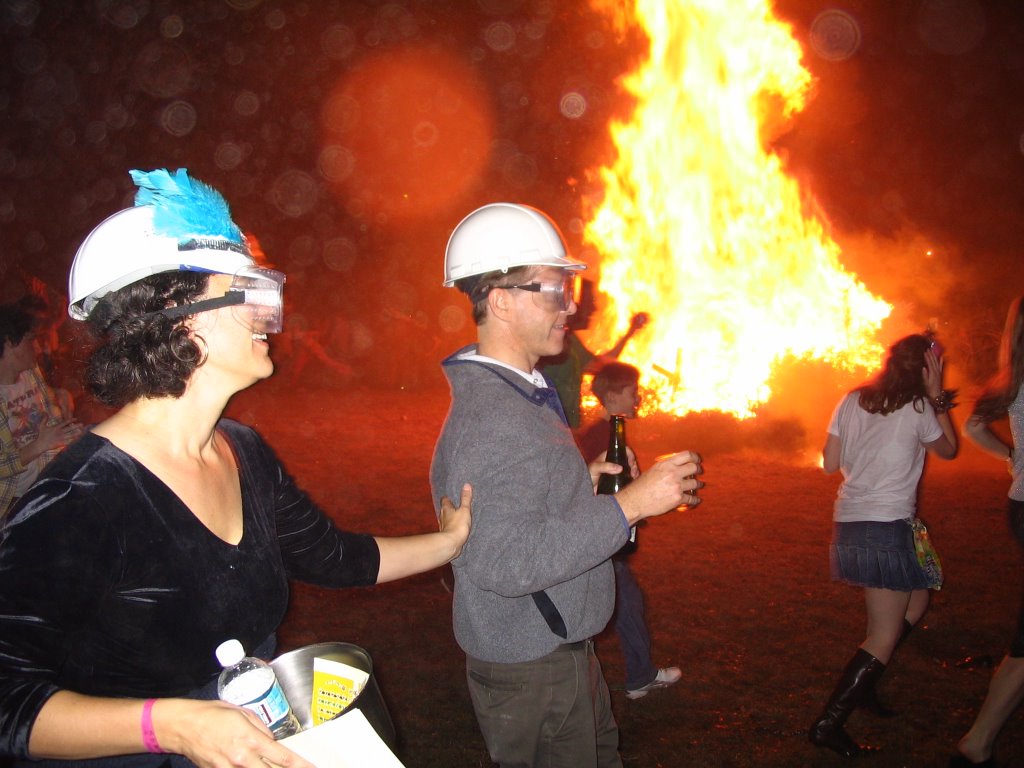
After the Schatzy gig at d.b.a, we went to the bonfires on the levee in Mid-City—an event that has occurred for decades, as I understand it, and we added our dried-up Christmas Tree to the pile that was ignited at midnight. The police and fireman presence was huge, but they let us be until the trees burnt themselves out, and I watched as friends ran in circles around the fire, gleefully, with abandon. The fire and policemen, even, seemed to be having a good time. There were kids there, too, and fireworks and sparklers and lots of fog—our Southern snow—that made the atmosphere even more, uh, magical. It was good, then, to be home.